

I have $40,000 waiting on the sidelines, ready to buy, precisely because the market is pricing in a chain that has been running for years. And it’s one you feel every single day.
During my years certifying helicopters, I learned to understand complex systems and to put my signature, and my responsibility, behind what I say.
It makes sense. Your life depends on it, because you’ll be the first one to fly it. The lives of the 15 people who board after you sign off depend on it too. So of course you work yourself to the bone to understand every system completely, so that if there’s a fault or a problem, you catch it. Right?
So let me ask you a question: why are your life, your money and your loved ones’ future riding on a world and an economic system that most people never bother to understand? With helicopters, the answer was obvious. Why isn’t it here?
The World
I’m going to speak to you as plainly as I’d want someone to speak to me. The world is, and always has been, a hostile place. It doesn’t matter that we were lucky enough to grow up with full bellies, in one of the longest periods of peace in history.
It seems that luck has made us forget that not so long ago, people had four children because two wouldn’t make it. Or that if you weren’t prepared, one year of drought could wipe out entire towns.
That’s the world human beings have grown up in for centuries. One where we’ve always moved in the same unbreakable cycle. Horrific chapters of history bring people together. They promise never to repeat the atrocities they’ve just committed. They promise to work hard, to rebuild a country or a civilization from its ruins, and to give their children a better future.
As the generations pass, the people who rebuilt the country and saw what humans are capable of die off, and the values that rebuilt it die with them. What’s left are their children, who have only ever known full bellies and the pleasures of life. Those children, and their children after them, devote their lives to power, money and pleasure, and leave behind every value that once built their country and made it great.
And that is exactly what fractures a society that was once united: the rich get richer, and the poor get poorer. Behind all of it, there’s always a broken economic system that allows these political and social divides, fuels them, and causes them.
The cycle comes back around, and this generation digs its own grave. The fights over power and money grow. The divides become impossible to bridge. And the weeds of war come back: the same weeds their great-grandparents watched sprout and grow beneath their feet, and then pulled out with death, sweat and sacrifice.
This generation will see what humans are capable of, and how cruel a world can be when you don’t bother to understand it until it’s too late.
The Big Cycle
What I just described is the cycle that built empires, and then watched them burn to the ground. The Roman Empire. The Spanish. The Dutch. The British. Every one of them fell the same way: a currency that lost its value, and a people who lost their values.
Which brings us to today. An empire born out of World War II, when people saw the very worst of humanity and promised themselves never again.
Everyone worked together to build the United States into the world’s dominant power, on the foundations of Bretton Woods, the petrodollar and the SWIFT system. A United States that opened the doors of democracy and capitalism to the world. And a people who turned a country into an empire.
But those people died. And now, only their children are left.
The Present
And that brings us to right now. The moment I’m writing this and you’re reading it. A moment in history defined by political polarization and an economic divide that’s almost impossible to close.
A world where a damn monkey in the jungle has a place to live and raise its family, but your young people don’t. They can’t afford a home, let alone raise a family.
Countries that call themselves the cradle of rights and democracy, and yet their young people have no future.
All of it caused by a people who lost their values. People who have only ever known full bellies and money in their pockets, who live for their own enjoyment and the pleasures of life.
People who taught their kids that life was a bed of roses. That they would get everything they wanted. That there were no limits.
But those kids grew up and found a broken world. One where they spend their lives working and still can’t afford a place to live. Where their jobs grind them down, their governments lie to them, and inflation eats almost their entire paycheck just to eat and keep a roof over their heads. Every month the prices go up, and every month there’s less in the shopping cart.
And on top of that, when they speak up, they get told it’s their fault. It’s the Netflix subscription. That’s why they can’t buy a $400,000 house that sold for under $100,000 forty years ago. That’s the answer they get from a generation that never bothered to understand the system and the world it lives in.
And I know that, because if they had bothered to understand it, they’d see why forty years ago one paycheck could buy a house and support a family, and today two paychecks can’t do either. If they understood it, they’d be ashamed to give that answer. And they’d be ashamed of the world they’ve left to their children.
That frustration in young people turns into extremism, on the right and on the left. Fascism and communism, back to their old tricks in a cycle that never ends.
Extremes that aim young people’s anger at an enemy that has nothing to do with what’s really wrong with their country. Communism points it at people with money. Fascism points it at immigrants.
And all that anger does is win them votes. Votes that win them power. Backed by people who have never felt in their own flesh what fascism and communism do to a country.
It’s not just that they never lived it. They never bothered to understand history either, or to look at how many people both extremes have killed over the centuries. They didn’t bother. But their parents, instead of teaching them the truth about the world, hid the worst of humanity from them. And now, like so many times before, these young people are falling into the same trap.
All because of generations that forgot that democracy means power of the people.
Generations that, instead of caring about the world and the system they lived in, gave themselves over to the pleasures of life. And let the economic, political and social system that once made them great die.
Have you ever asked yourself why your kids are never taught anything about money? Have you ever asked why they’re told they need a huge house, an expensive car, two vacations a year and the latest iPhone? Could it be that if you teach people to live their whole lives in debt, they’ll keep working until their very last day? And could it be that if they live paycheck to paycheck, with no safety net, anyone can do whatever they want with them?
Have you bothered to ask why home prices never stop rising, no matter which party is in power? Why the money printing never stops, no matter who’s in charge?
And have you stopped to think that the more polarized you are, the more you hate each other, the more you fight left against right, the less power you have? Because a divided people is never a threat.
Because while you point fingers at each other, whoever gets into power lies, steals, manipulates, and gets bought by people with power and money. So they only look out for them, and couldn’t care less about the people.
And it doesn’t matter which party. All of them stole your children’s future right under your noses, and nobody said a word. Because you were too busy fighting each other and chasing pleasures that were supposed to make you happy.
And so the cycle goes on. The divides grow wider. The polarization grows more extreme. And the system breaks. When it breaks, the atrocities come back. And out of that suffering and that pain will come the generations that make a country great again. If there’s anything left of it.
The End of Peace
The United States, once the unchallenged dominant power, now faces a rival. China. A country of 1.4 billion people that has topped almost every growth ranking for decades.
Many people believe peace exists because human beings are good. I believe the exact opposite. For eighty years, no one has had the economic or military power to stand toe to toe with the dominant power. That’s what gave us what we’ve all lived through. A long period of peace across most of the world.
Now that dominant power is being challenged. And as it has every time in history, the peace that came with it is under threat too.
Because history is very clear about what happens when two great powers fight for control of the world. First comes an economic war. If that’s not enough, a proxy war. And if that’s not enough, a direct confrontation, until one of them gives in.
Sometimes, and this is our hope, the dominant power simply accepts that it’s going to be overtaken. Unfortunately, that’s not what’s happening now.
The Heart of the World
Now that we understand what has always moved the world, and the moment we’re living in, let’s look at where we’re headed.
We’ll start with the heart of the economy. Oil. Throughout 2026, the United States has been putting pressure on the entire global supply chain. Why?
Because it’s already in an open war with China. Stage two, the proxy war. Which means it has to fight to keep its place as the world’s dominant power, and to hold on to its economic and military control.
To win this war, it only needs one thing. Power. And power only comes from one thing. Money. To get that money, you need to pull in as much of the world’s capital as you can. And to do that, you need strong capital markets and a strong dollar.
A strong dollar crushes everyone else, especially emerging markets. Why? Because their dollar debt becomes much harder to pay back. Global investors see this and pull their money out of those countries. And where do they put it? In the United States. In its bonds and its stocks.
It works the other way around too. When the dollar falls, capital flows out of the United States and into emerging markets, which can now not only pay their debt, but borrow even more to grow.
So if the United States needs a strong dollar, strong capital markets and as much of the world’s money as it can attract to win a war with China, how is it going to do it?
With an oil crisis.
The Supply Chain
The United States has been following a clear plan since early 2026. While everyone says they have no idea what they’re doing, I’d like you to look at this.
These are the world’s biggest oil exporters.
United States. The world’s leading exporter of crude and refined products.
Saudi Arabia. Its refineries attacked by the Houthis.
Russia. Its refineries attacked by Ukraine.
Canada. Under pressure from the Trump administration.
Iraq. Trapped behind the Strait of Hormuz, with shipments down 76%.
United Arab Emirates. Named by Iran as its main target.
Iran. In a direct war with the United States.
Now, a question. Do you really think it’s a coincidence that every single one of the world’s top oil exporters, except the United States, is under threat or in open conflict?
And let me be clear. I’m far from a believer in conspiracy theories. I believe in power, money and incentives.
But wouldn’t a global oil crisis hurt the United States too? Of course it would. But there’s something you need to understand, and it doesn’t just apply to the world. It applies to your own life too.
If everyone else loses five and I lose one, I’m the one who wins. Even though we all lost.
The Stock Market
Now you might say, “But J.C., if they cause a global oil crisis, wouldn’t the stock market fall?” Yes, it would. And, in the right dose, that’s exactly the point.
A drop in the stock market would flush out all the excess and leverage in the system. And, paradoxically, it would set the stage for a very bullish 2027 and 2028.
Why do they want markets that strong? Because they need to fund the artificial intelligence race. They need to build every data center that will make them the dominant power in AI for the next twenty years. Just like in the late 1990s, when a roaring market funded the infrastructure of the internet.
That boom made the United States the dominant power in that technology, and gave it some of the most important companies in the world, like Google and Amazon.
To launch those bullish markets in 2027 and 2028, and pull in as much of the world’s money as possible, they first need a correction. And then an excuse.
An excuse to print more money. An excuse to pump liquidity into the markets, refinance their debt, and keep printing and printing.
So What Is the Market Pricing In?
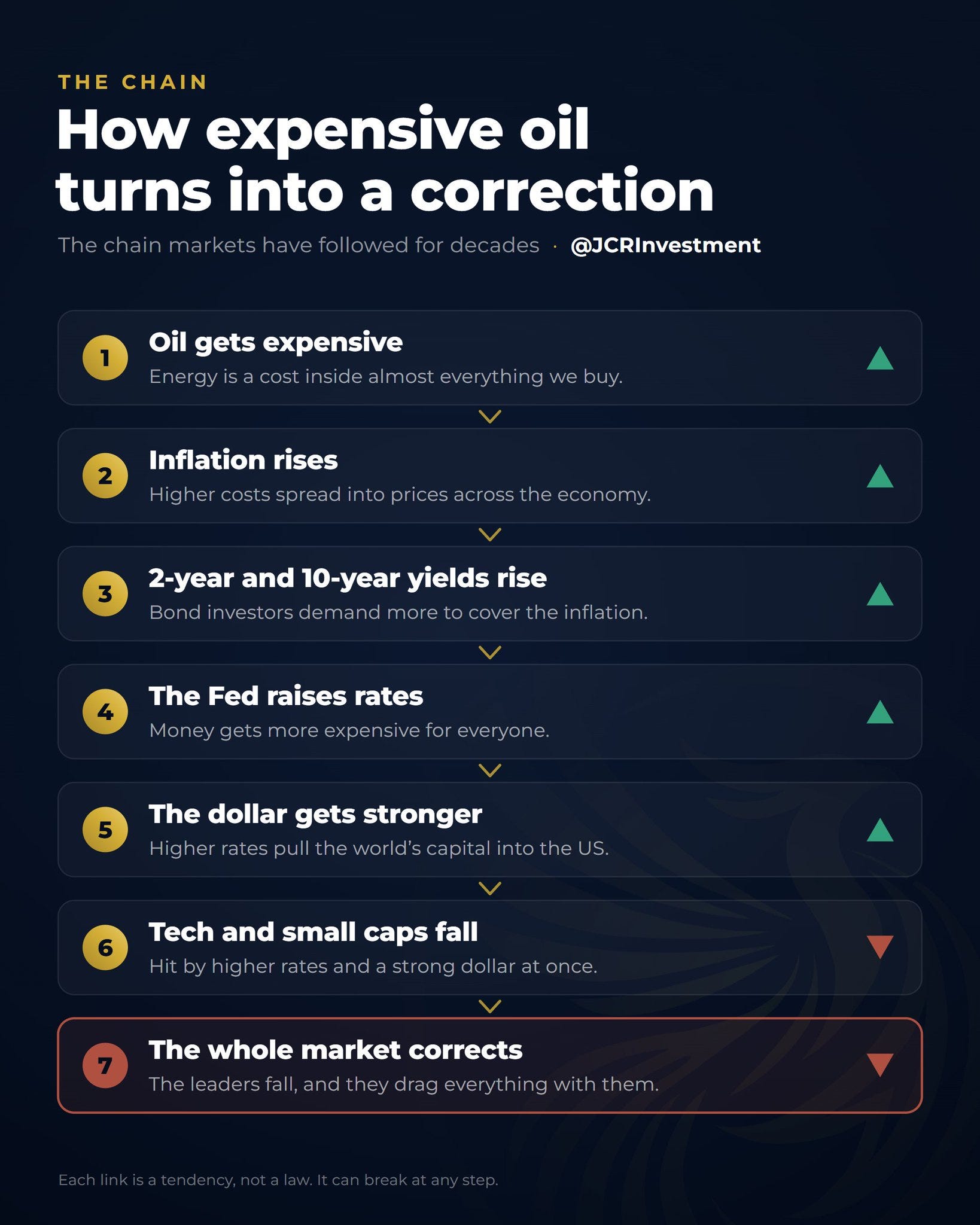
Exactly this. A market correction and an oil crisis, following the same chain that has played out for decades.
OIL
First, oil, the energy heart of the world.
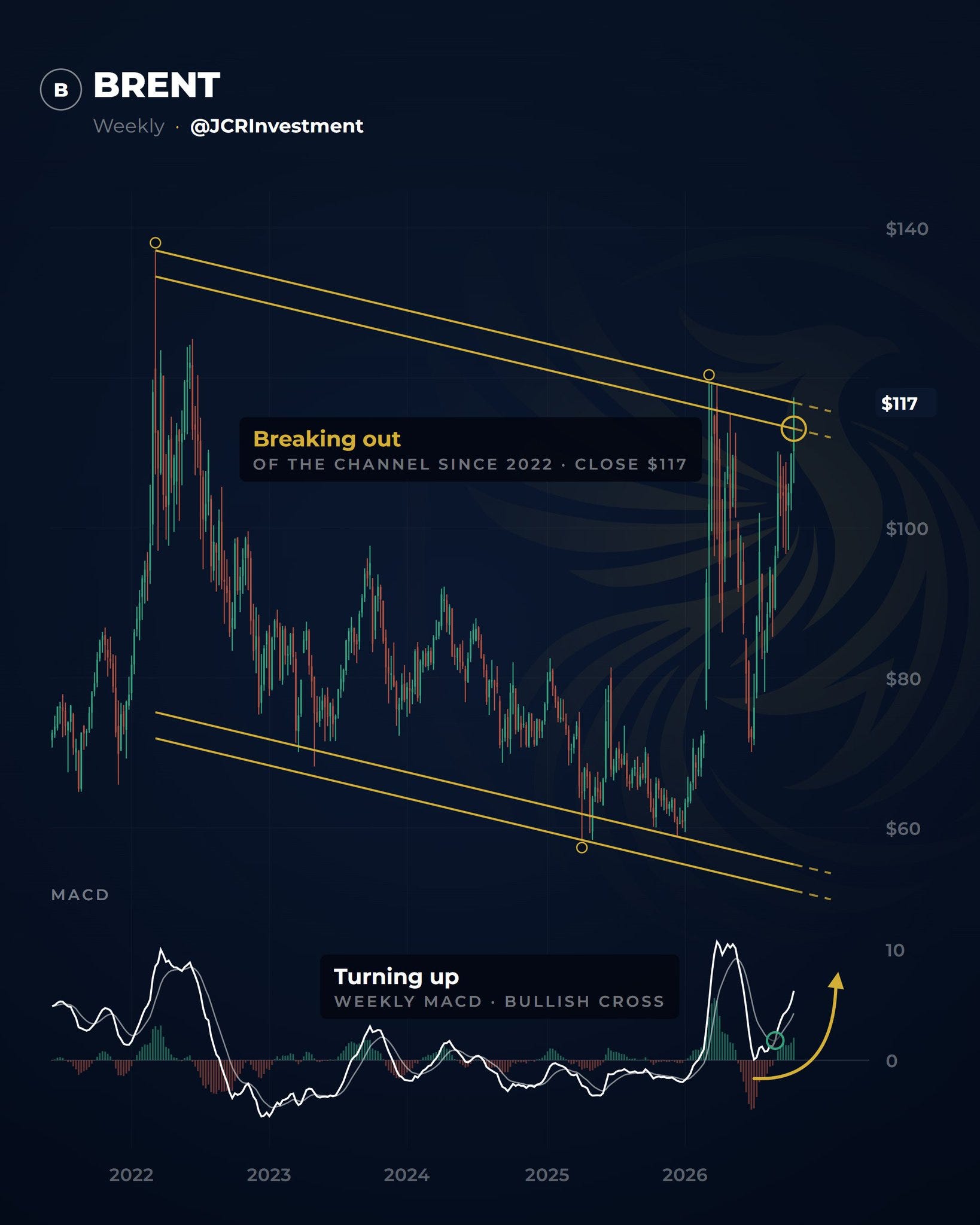
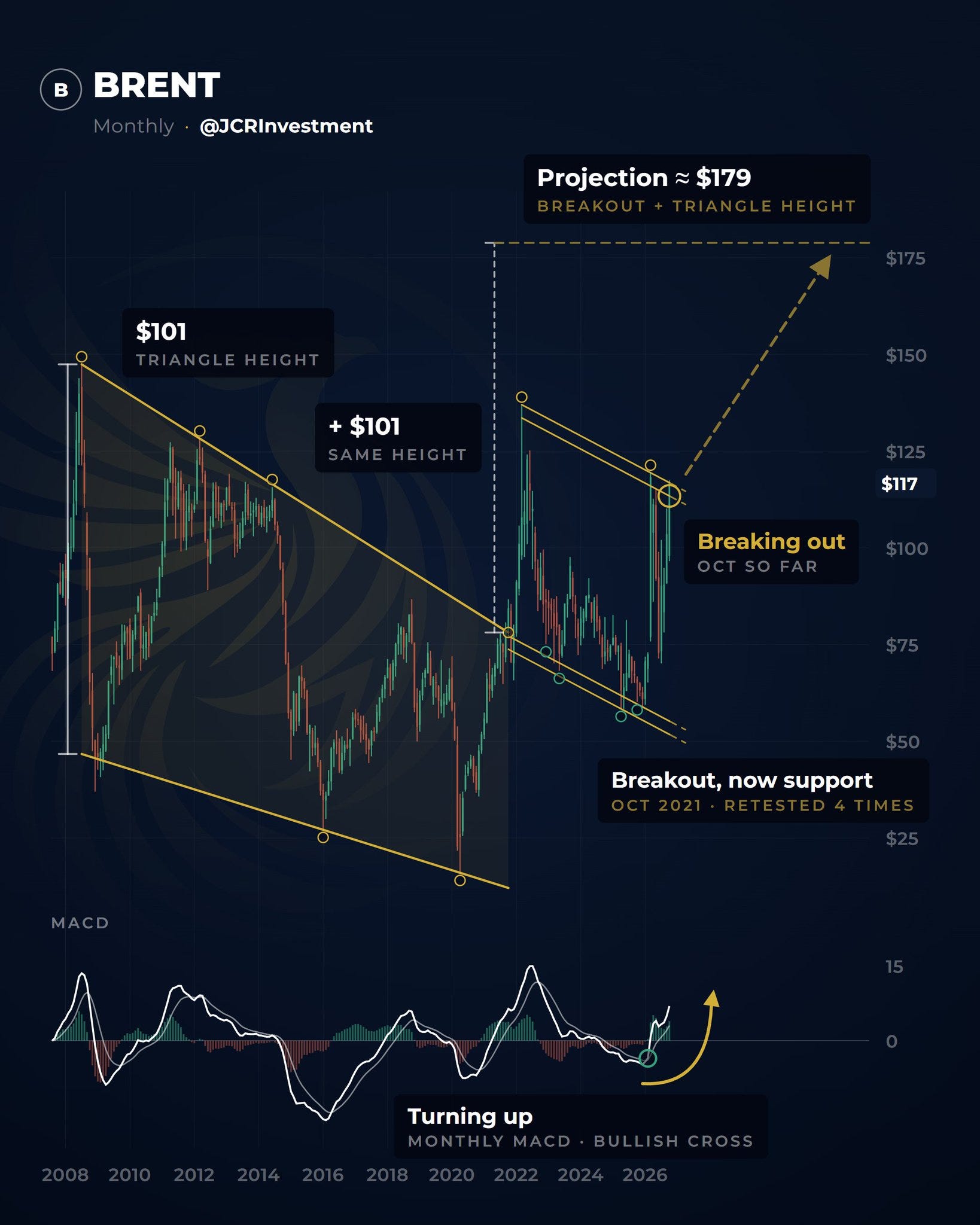
Oil is breaking out of the downtrend channel it has been stuck in since 2022. At the same time, the long-term triangle projects a move toward roughly $180, and its momentum indicators have all turned up.
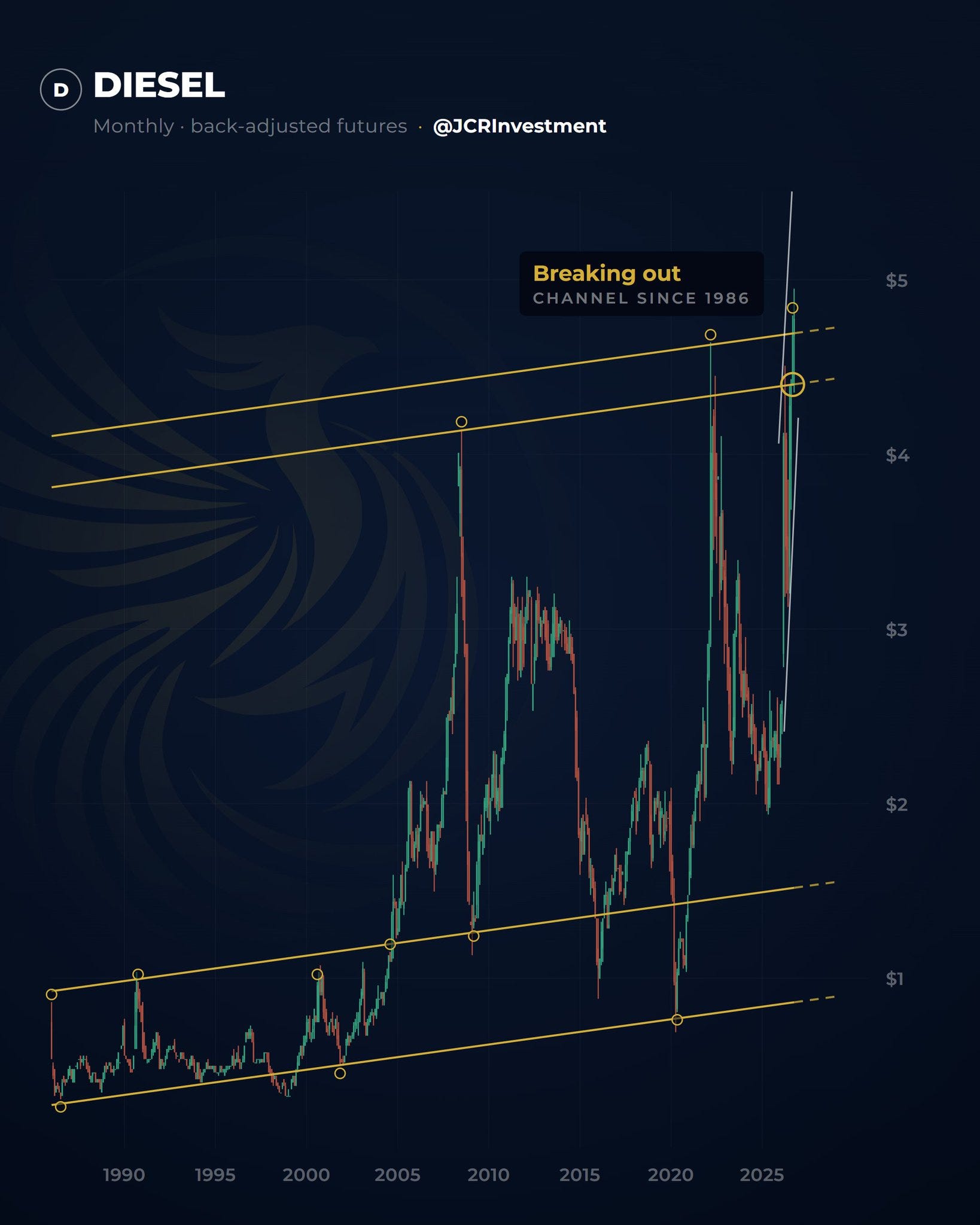
If oil is the heart of the economy, diesel is the heart of inflation. Almost everything you buy was made or moved with diesel. When its price rises, it hits everyone’s wallet, directly or indirectly.
Diesel has just broken above a channel that held for decades, and now it’s resting on top of it. If that holds, my read is that diesel’s uptrend is clear. And combined with oil’s, even more so.
All these bullish signals come from the same place. Strain across the entire supply chain for oil and its products, where six of the world’s top seven exporters are in trouble.
BONDS
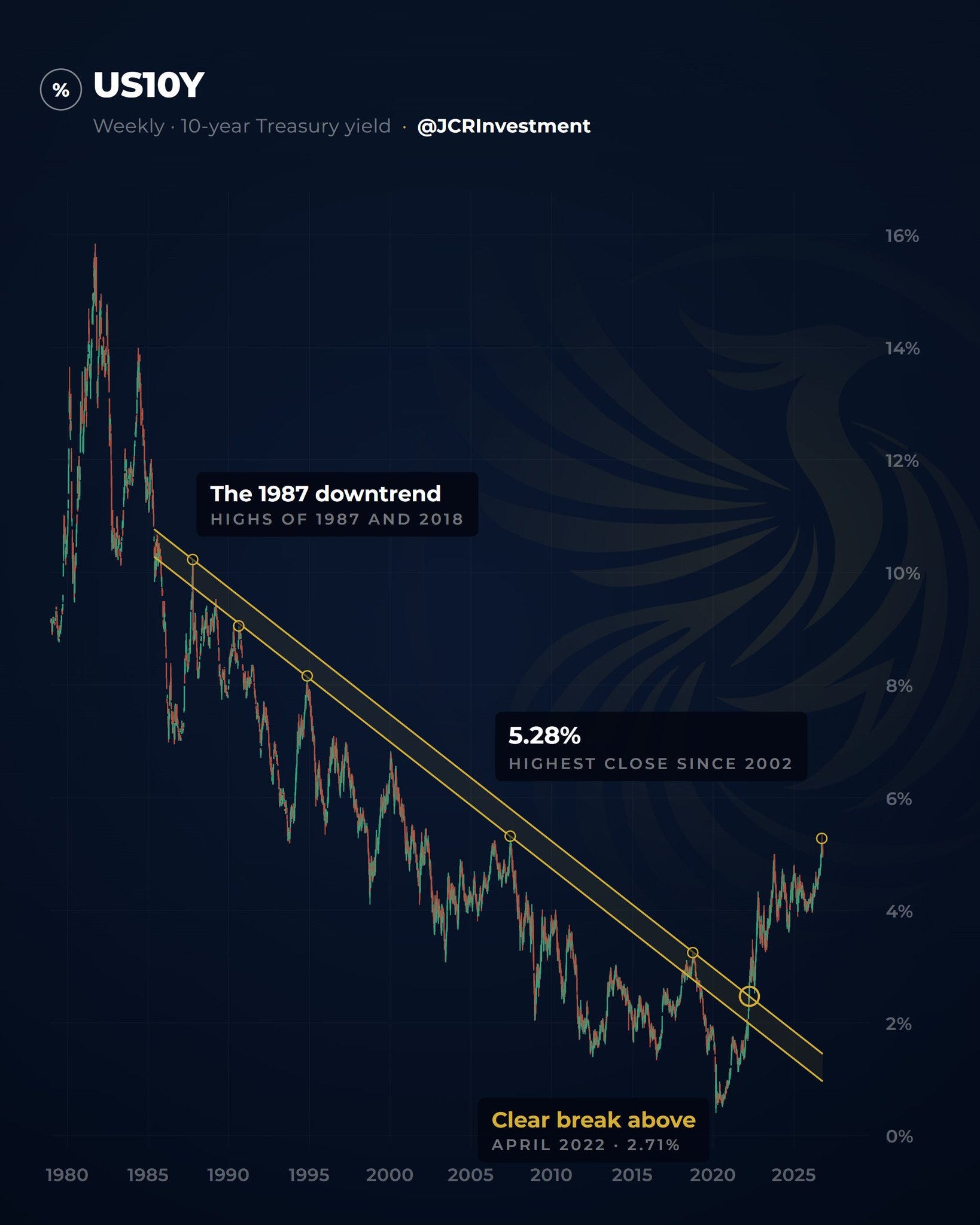
Bonds have already started to price in higher, more persistent inflation. On one side, commodities are rising. On the other, there’s massive money printing and debt, which has bond buyers wondering whether governments will be able to pay back what they owe.
THE DOLLAR
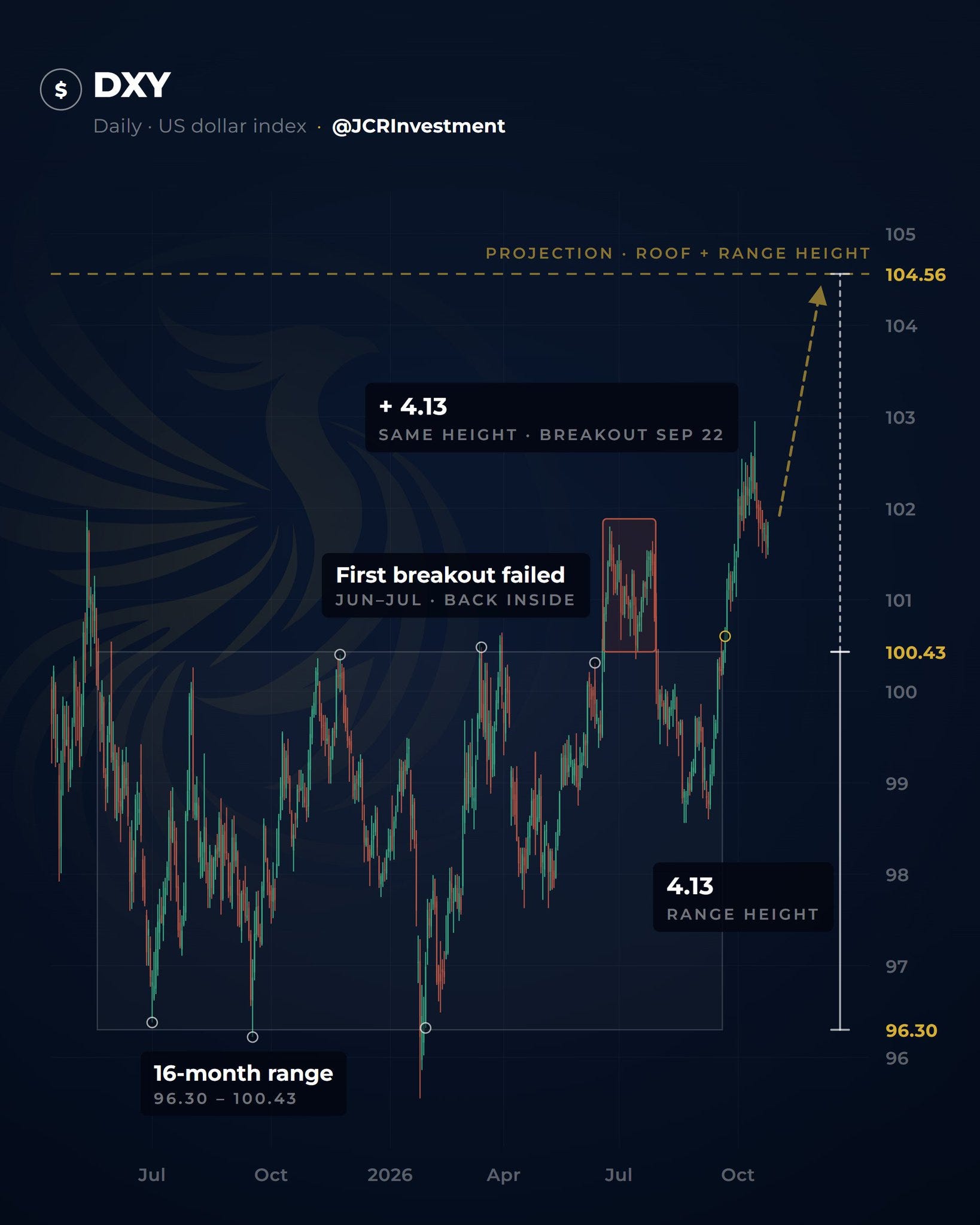
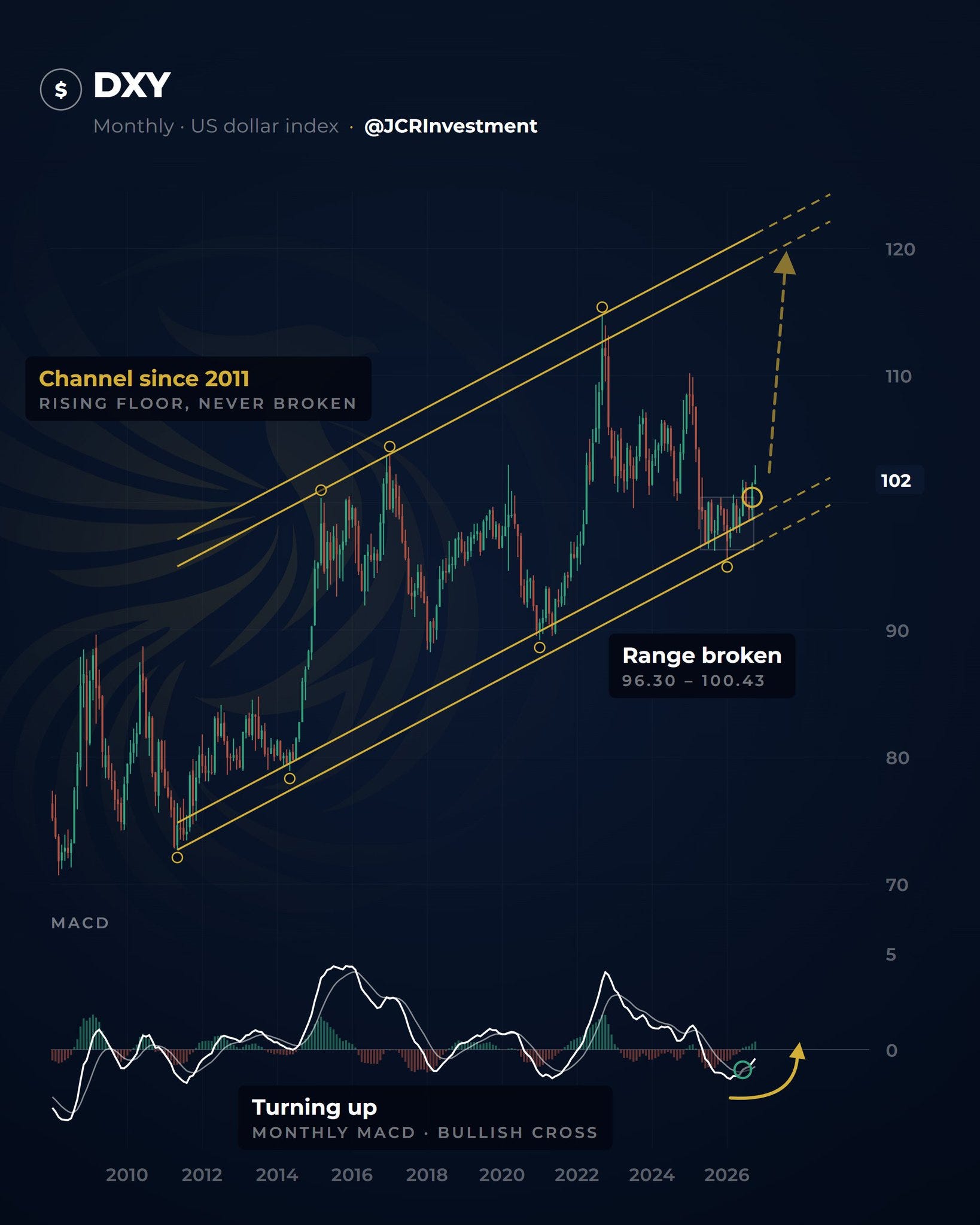
And the dollar has already started to price in that the Fed will have to raise rates, and that the United States will be the world’s safe haven when trouble hits. Every one of its charts is flashing bullish signals.
Dr. Copper and the Old King
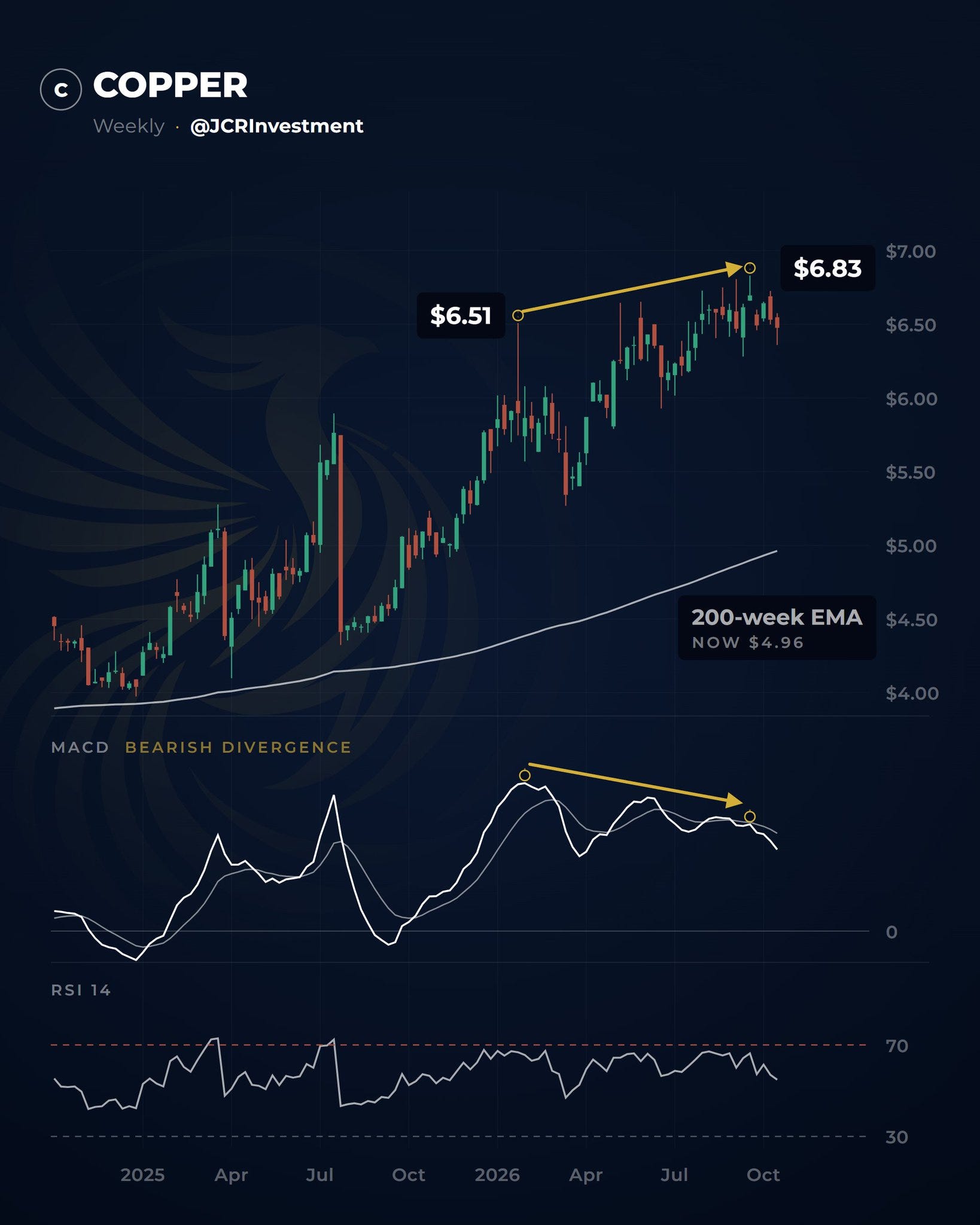
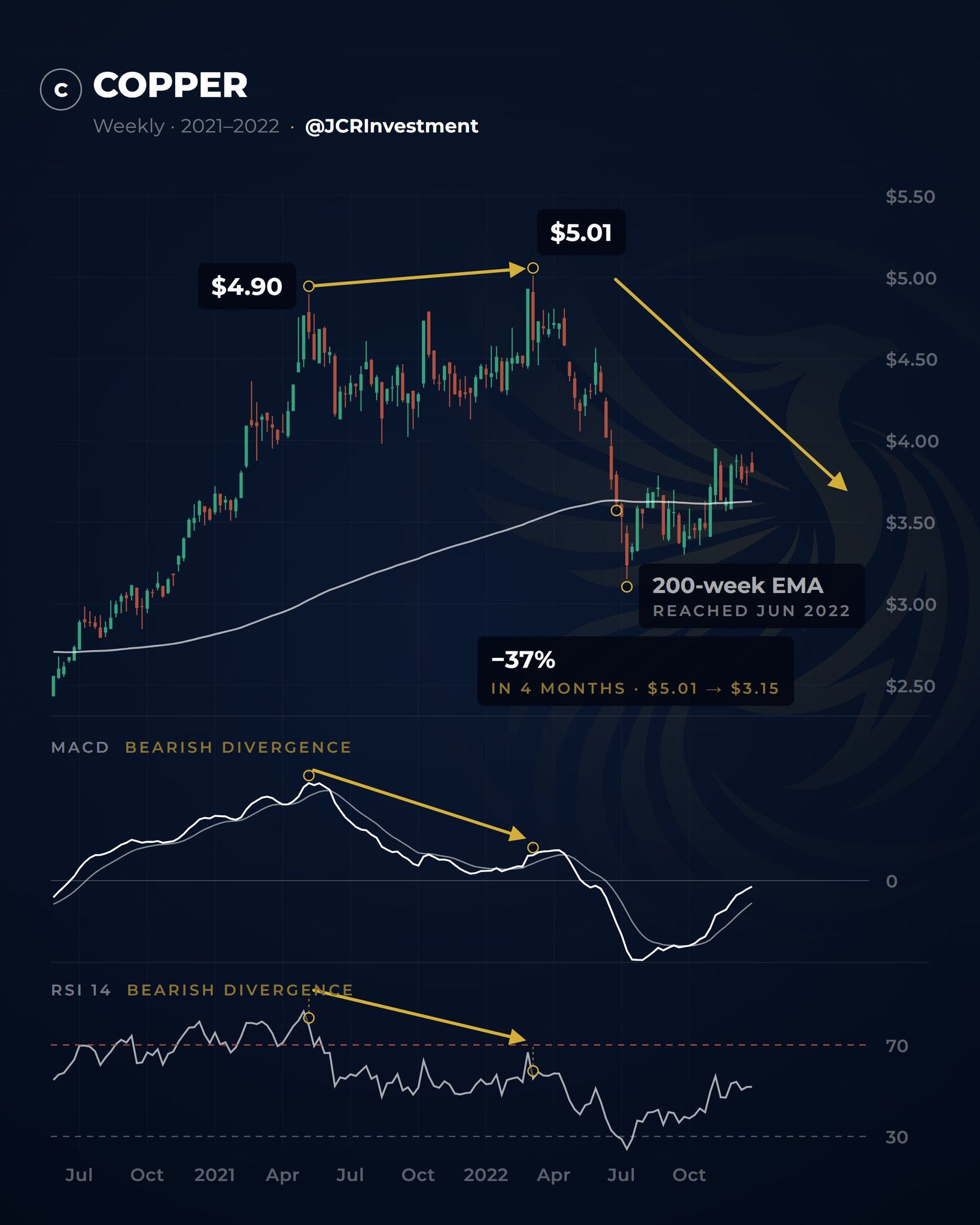
Copper is one of the first commodities to warn of trouble in the economy. The logic is simple. When copper is rising, the economy is doing well. When it’s falling, the economy is in trouble.
It all comes down to demand. A strong economy uses more copper across every industry, which pushes the price up. A weak one uses less, and the price falls.
Right now, copper has just flashed a major bearish signal. The last time I saw it was in 2022, and copper fell 37% in four months.
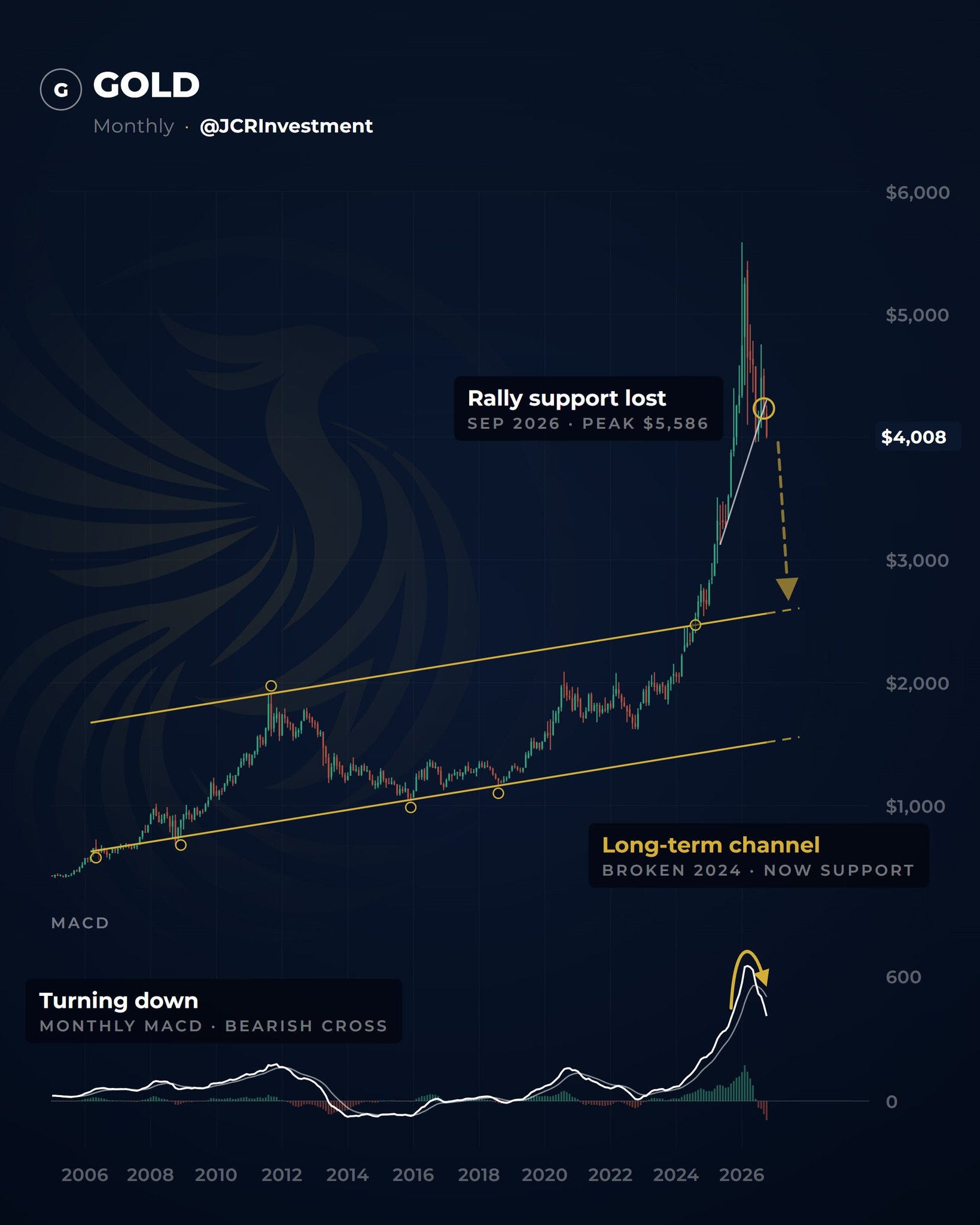
As for gold, its long-term uptrend is undeniable. It’s an asset that has served as a store of value throughout history, and it has survived every cycle of war and peace humanity has ever been through.
In the short and medium term, for now it’s signaling a correction. In my view, it could come back down to rest on its old channel, and from there start a new, very strong uptrend. The more money gets printed and the more conflict there is in the world, the better it tends to be for gold.
BONUS
There’s one more thing I want to add, because it could spread through the media and people may start talking about a carry trade crisis.
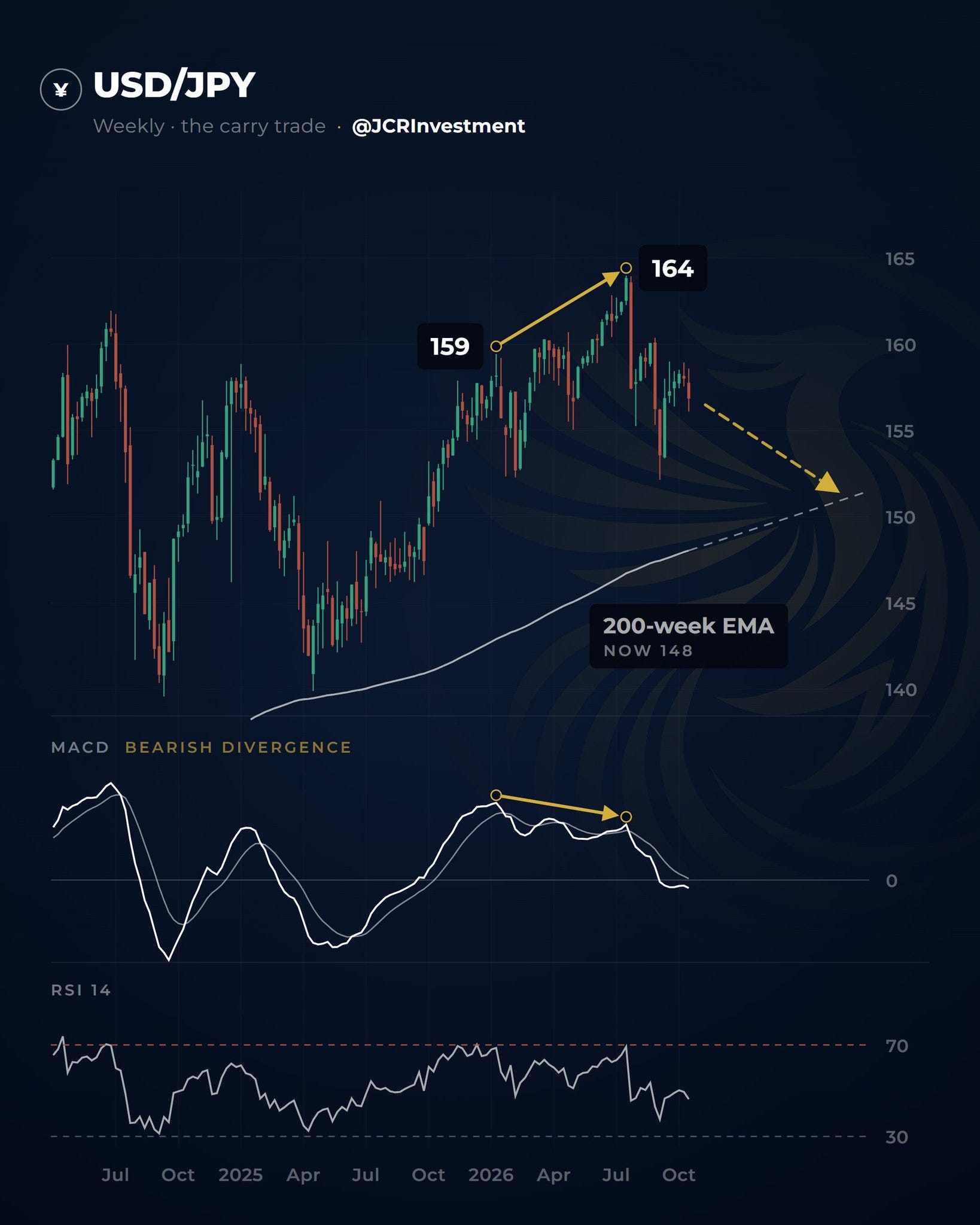
The carry trade props up a significant part of the world’s markets. It works like this. You borrow yen at almost zero interest, convert them into dollars, and invest them in markets that pay more than Japan’s.
When the interest rate gap between Japan and the United States narrows, the trade stops paying off, and people sell their US positions to pay back their yen debt.
The same thing happens with USD/JPY. When it rises, the yen gets weaker, the yen debt gets cheaper, and the trade keeps paying. When it falls, the yen gets stronger, the debt gets more expensive, and people are forced to sell their dollar assets to buy back yen. That buying makes the yen even stronger, which forces even more selling.
USD/JPY is already warning that problems are starting to show. It’s flashing a major bearish signal that could trigger a pullback toward its average, and with it, a wave of selling in US assets.
MAJOR INDEXES
We’ve reached the last link in this chain. The major indexes tend to be the last to fall, but once they start pricing in what every other asset has already been signaling, they fall fast and hard.
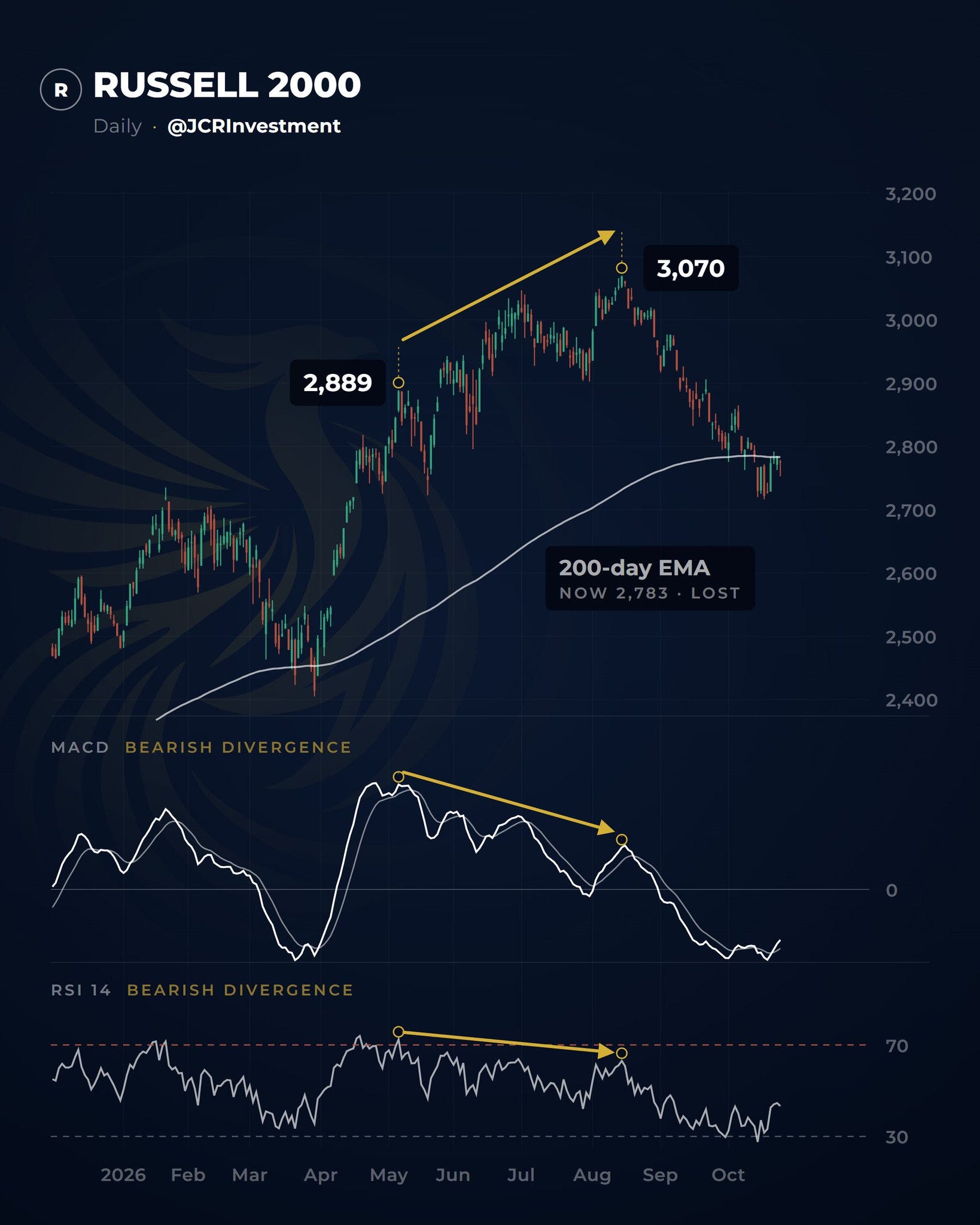
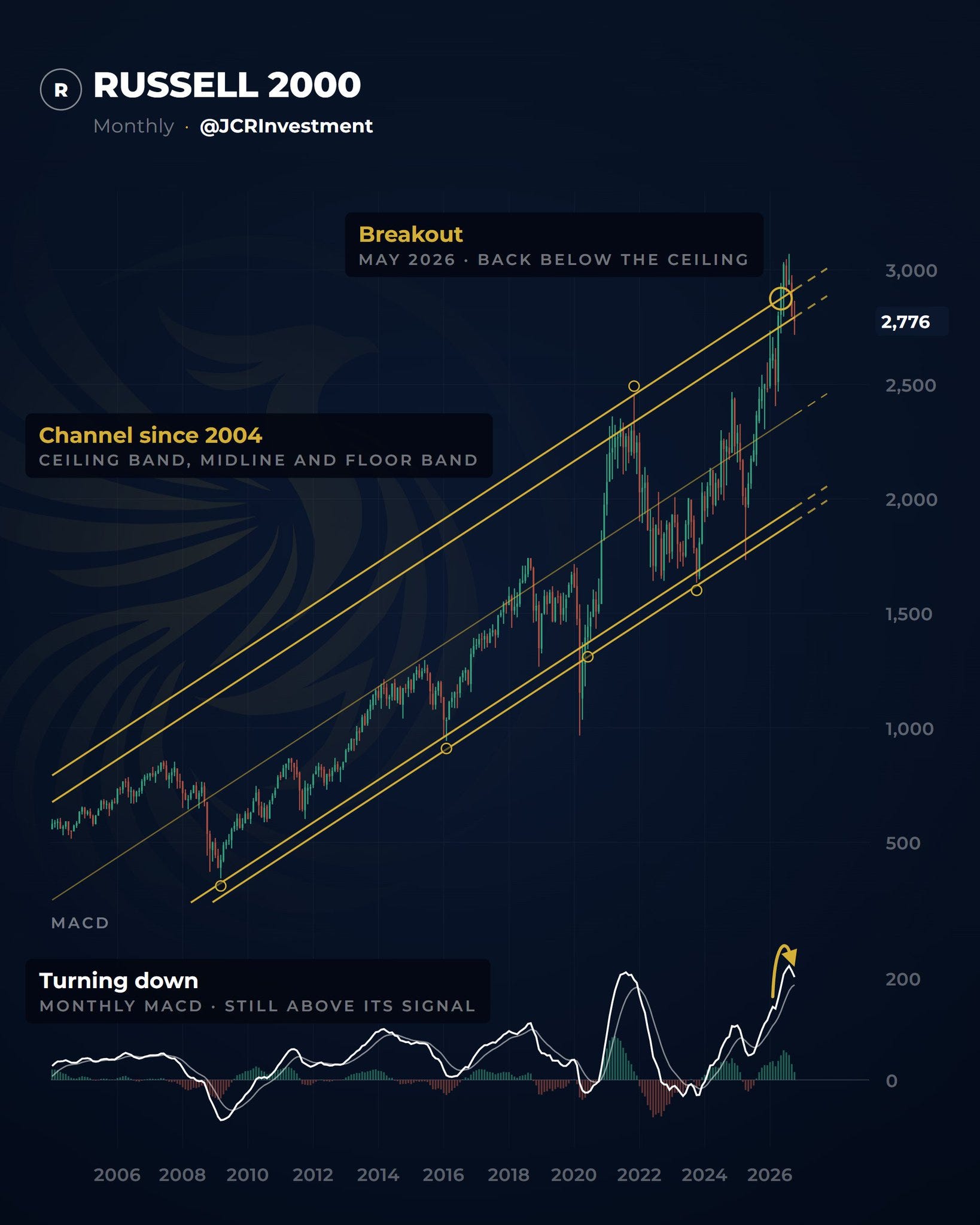
The first and most volatile to react to a world of inflation and high rates are small and mid-sized companies. As I write this, the Russell 2000 is already in a correction. It flashed a bearish signal in the middle of this summer, it’s already down nearly 10%, and it has just lost its 200-day average.
On the monthly chart, it’s forming what’s known as a bull trap. In May it broke above its long-term channel, but it did so with a bearish divergence on the daily chart and with its monthly MACD turning down. In my view, it’s a bull trap that could lead to a correction toward the lower part of its channel, and from there a strong bounce. But we’ll have to watch how it plays out. For now, everything seems lined up for it.
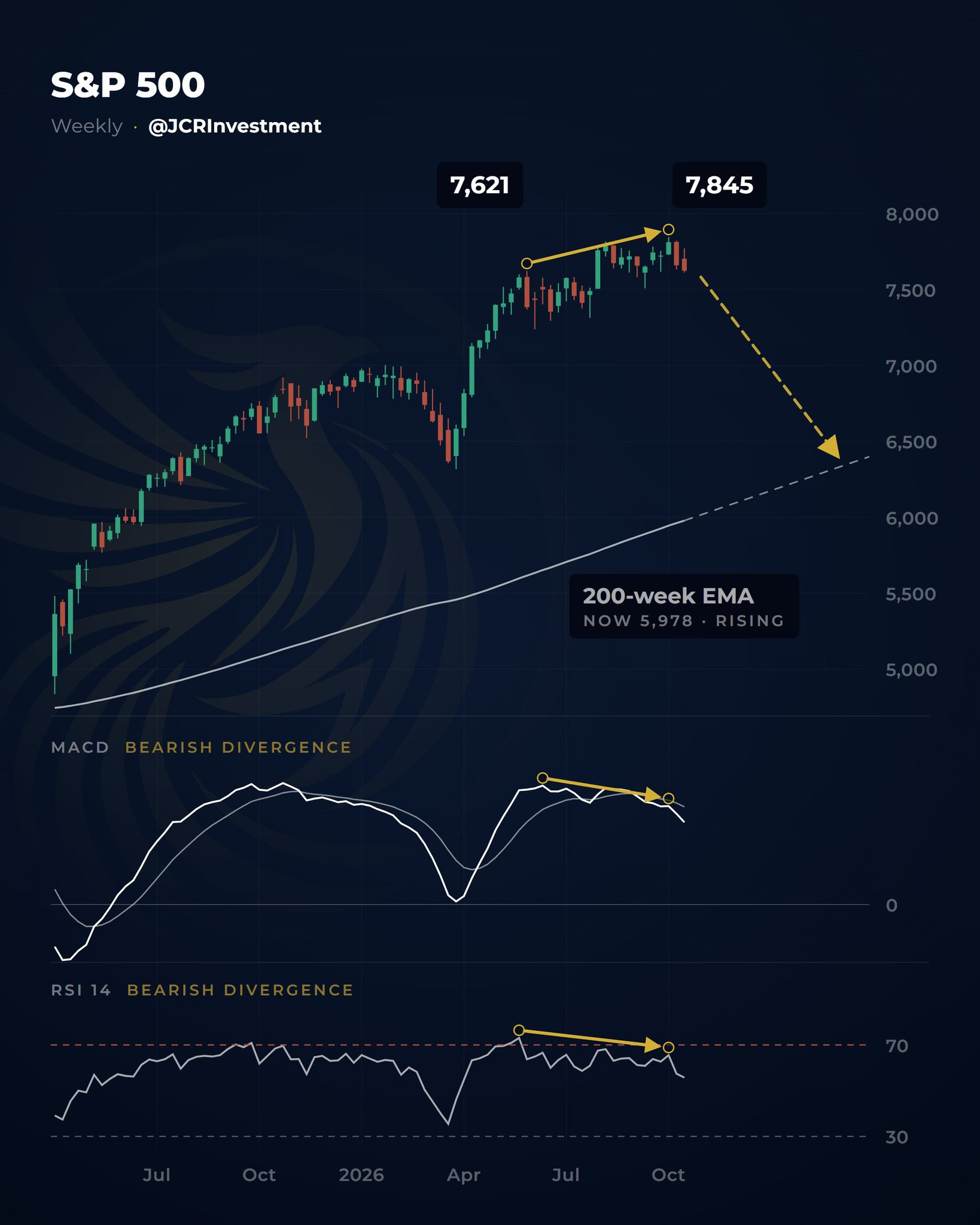
Finally, the biggest ones. These indexes tend to be the last to move, but they’re already sending bearish signals again.
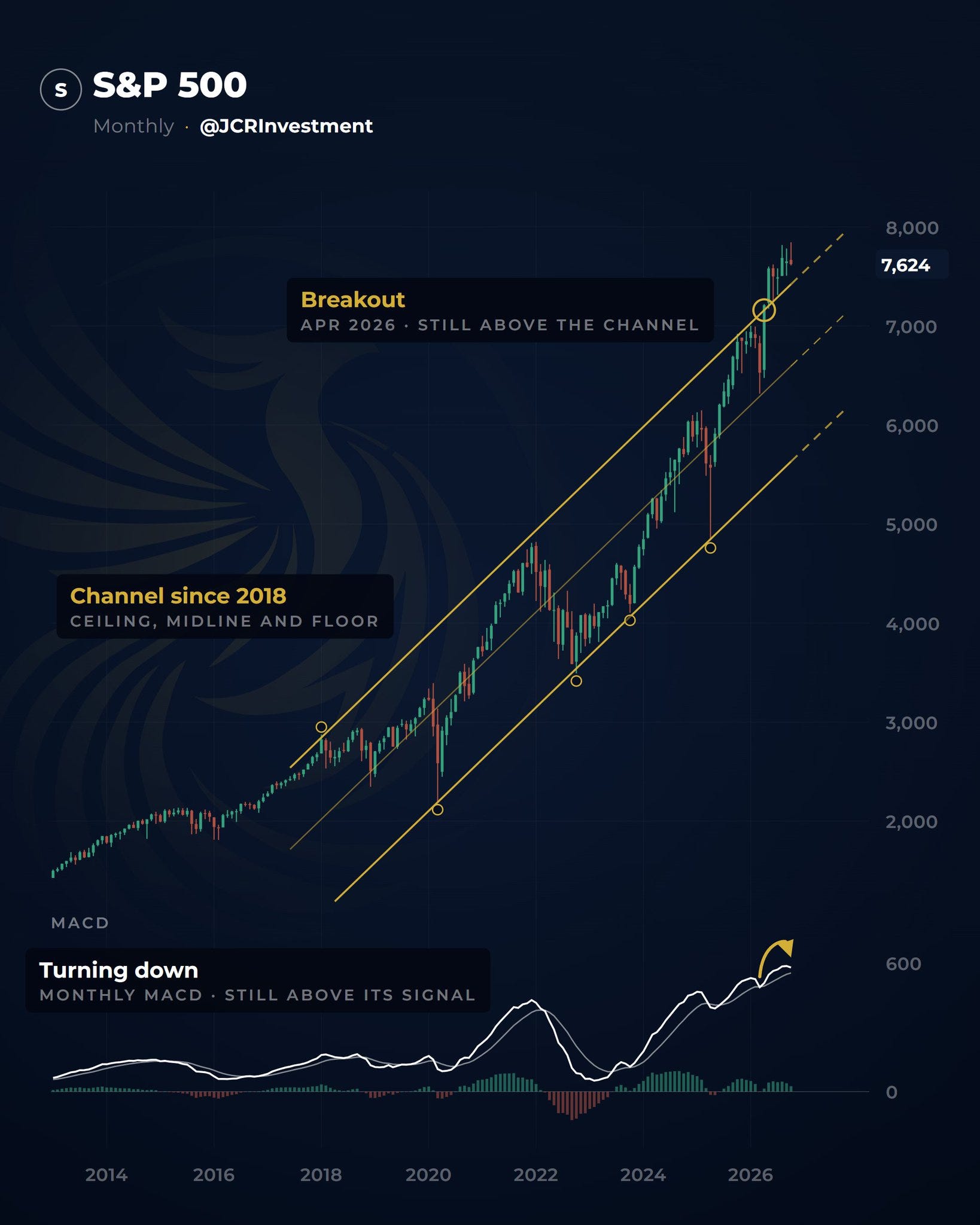
The S&P 500 is the index that leads the world’s stock markets. It has just sent bearish signals, and like the Russell, it may be setting a bull trap. It broke above its medium-term channel, but once again, it did so with a bearish divergence on the weekly chart and with its monthly MACD starting to turn down.
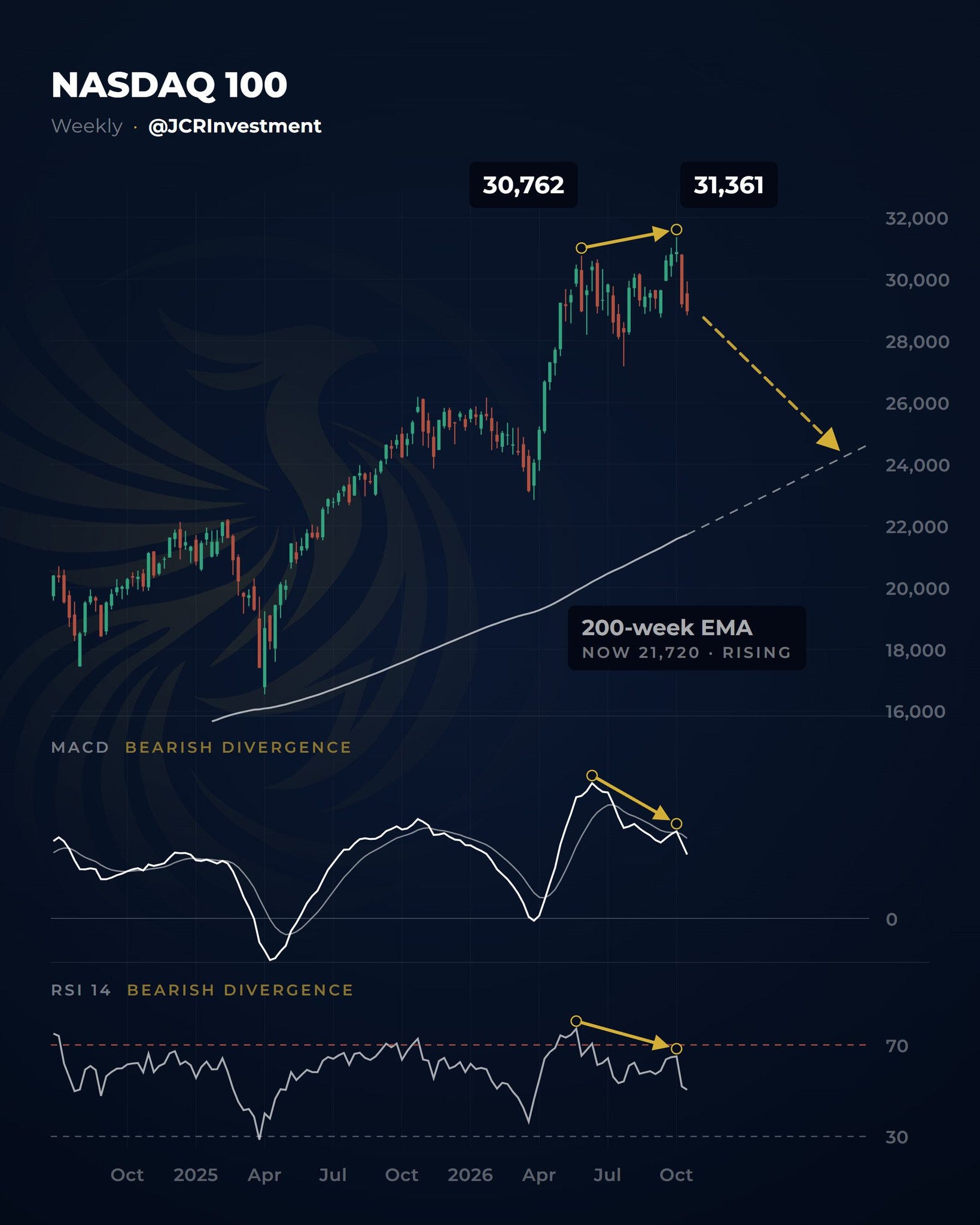
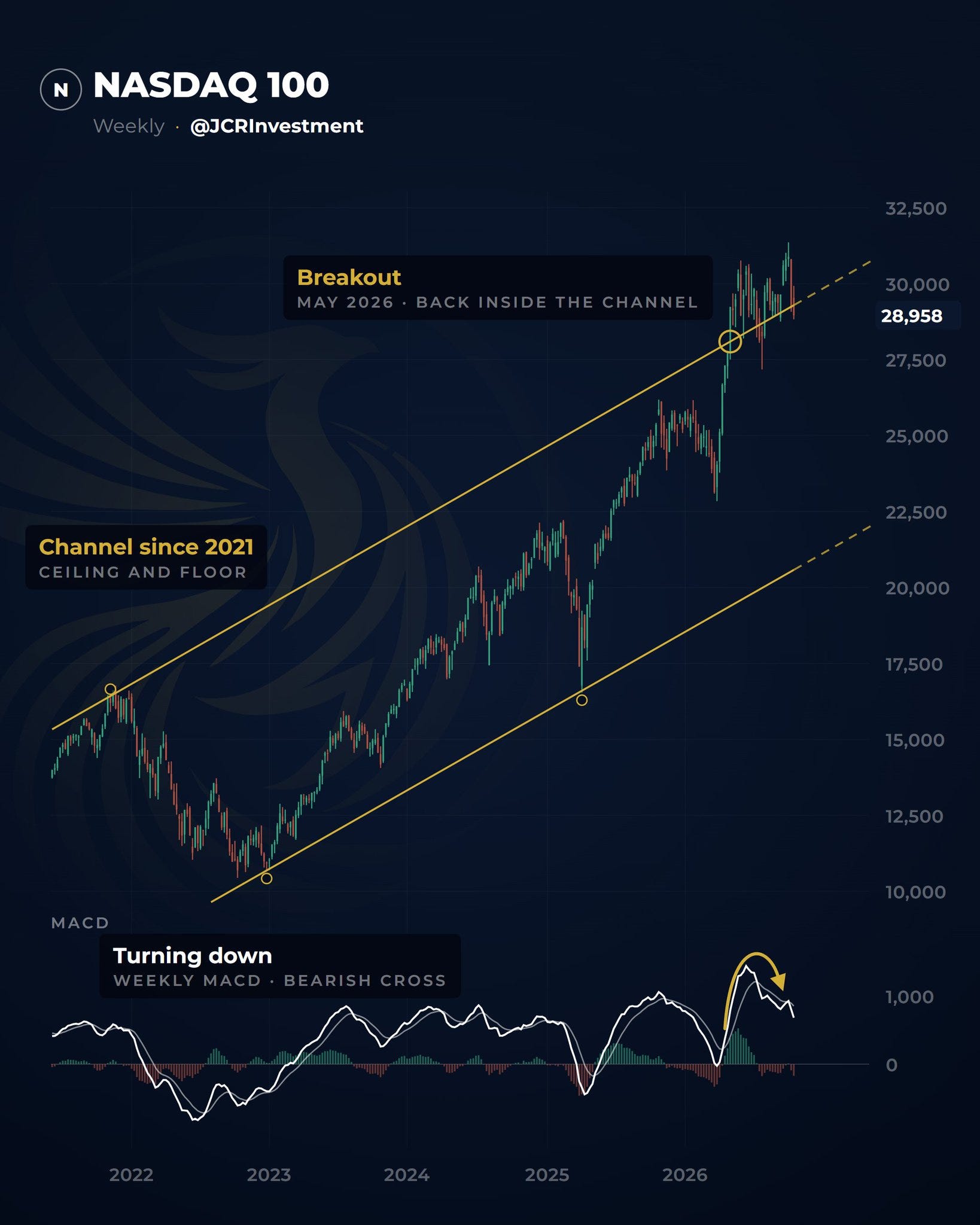
The Nasdaq 100 is another index that would be hit hard by the scenario the market is starting to price in. Once again, it’s signaling a correction, and it’s following the same pattern as the S&P 500, a possible bull trap.
THE LEADERS
Over these eleven years, I’ve noticed that when a correction starts, it almost always starts the same way, in the market’s leaders. First they flash bearish signals and start to fall. The indexes stay up, because money rotates inside them, out of the most overbought names and into the most oversold.
Then the leaders keep falling, and the final wave of selling hits. Right now, the leaders are once again flashing major bearish signals.
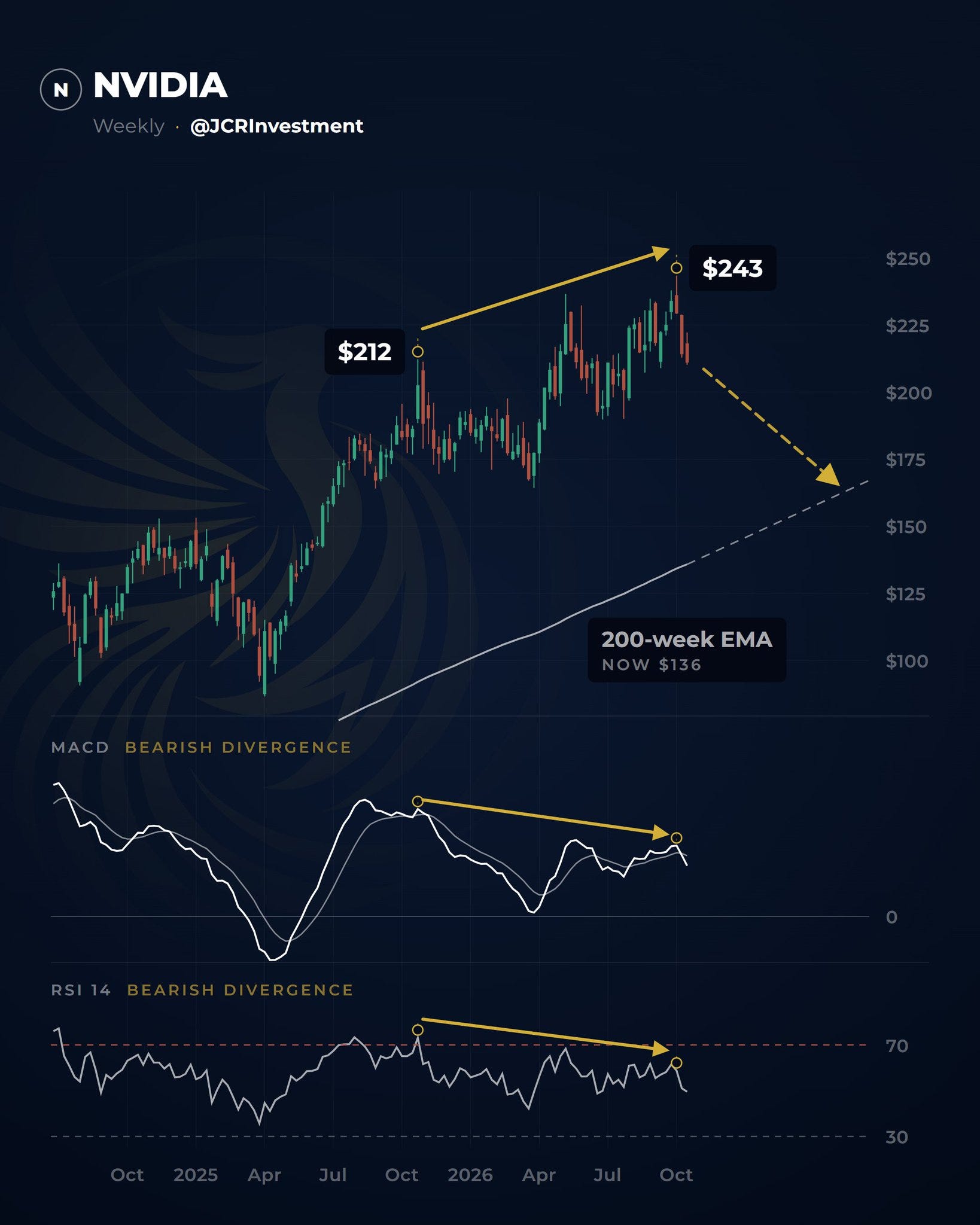
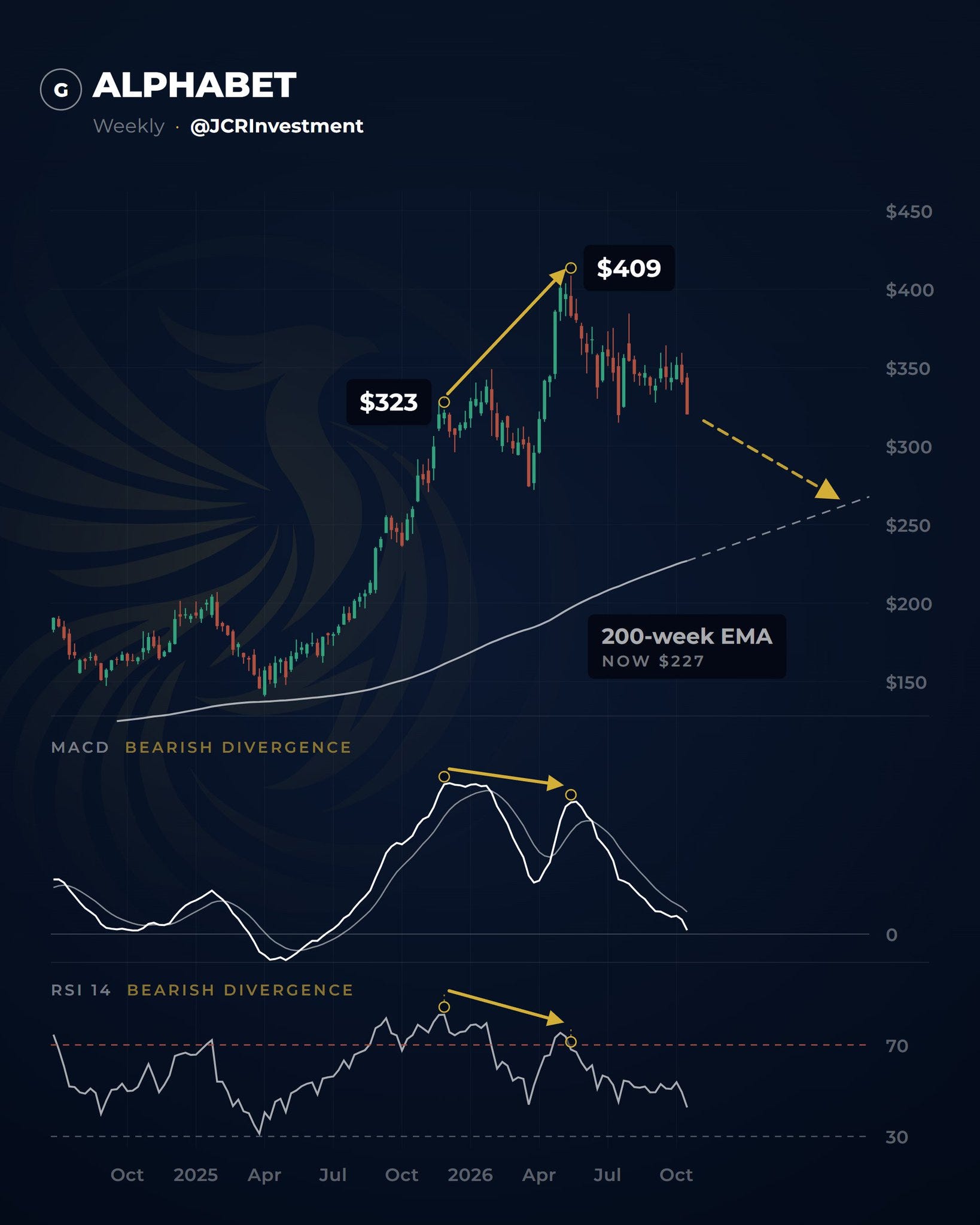
These are just a few examples of bearish signals that have shown up across a wide range of sector leaders in tech, which carries the most weight in the indexes.
In Short
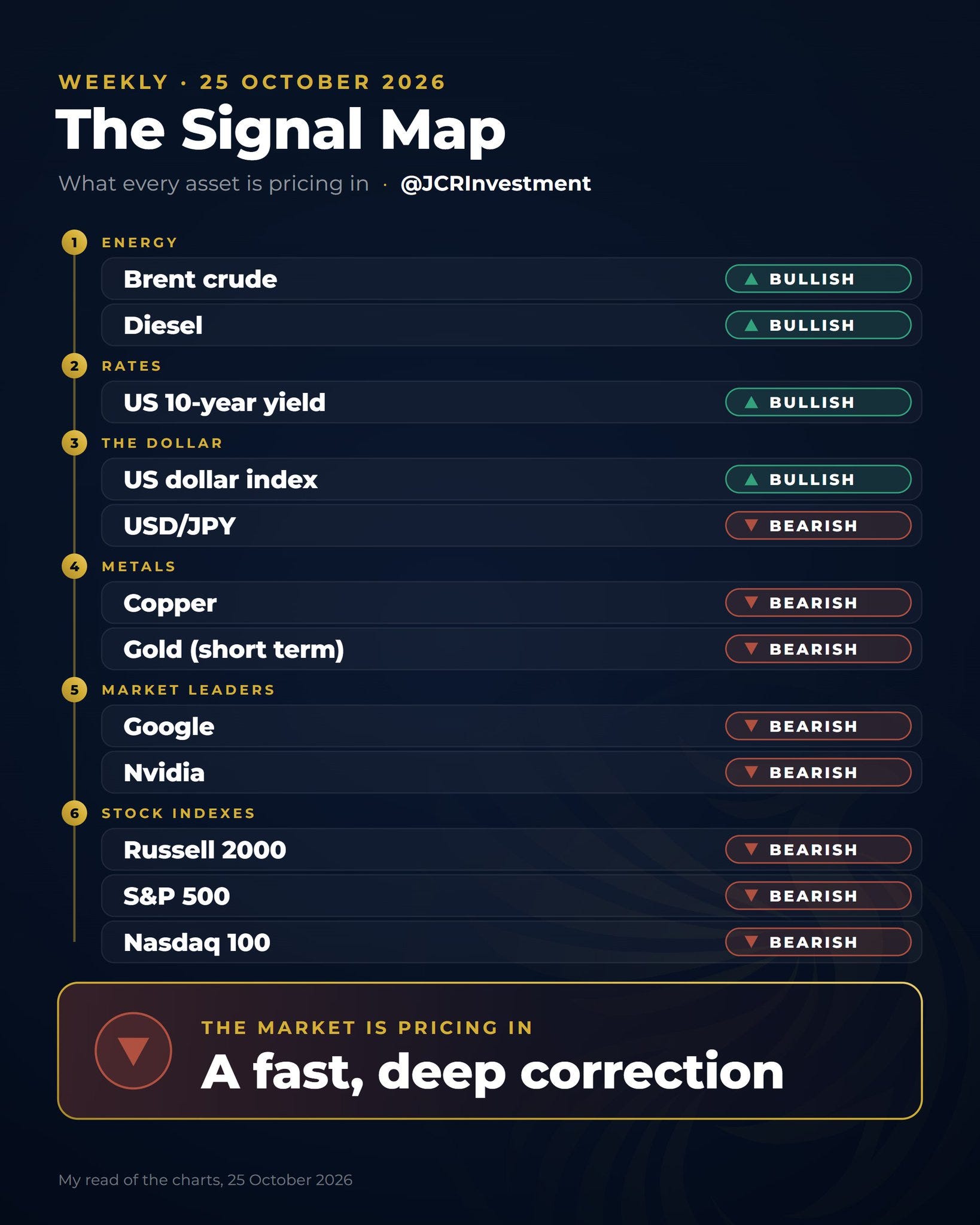
Every asset in the market is following the same chain that has played out so many times before. Together, they’re pricing in a correction, a fast and violent one. I don’t know what excuse the media will use for it, whether it’ll be an oil crisis, a carry trade crisis, or something else entirely. What I do know is that every asset is lined up in the same direction, all at once.
The market is getting ready to fall.
And How Do You Know It’ll Only Be a Correction?
I can’t know for sure. But here’s why I think so.
First, because of everything we’ve covered. I don’t count on human goodness. I count on incentives, interests, and the fact that a lot of people’s money is riding on a very bullish 2027 and 2028 in the United States.
Second, they’re not going to stop printing money. And the more money they print, the more they debase the currency, the more inflation there is, and the higher stocks and gold tend to go.
From 2020 to today, inflation has soared, home prices are up almost 60%, and your children’s future has been wrecked.
They tell you it’s the fault of wars and conflicts abroad. What nobody tells you is that in 2020 and 2021 alone, the US created about 28% of all the dollars in circulation. In just two years, it added almost half as much money as it had in the previous forty. Of course inflation took off.
A good thermometer for this is M2. It isn’t every dollar in existence, but it’s a good gauge of how much money is being printed.
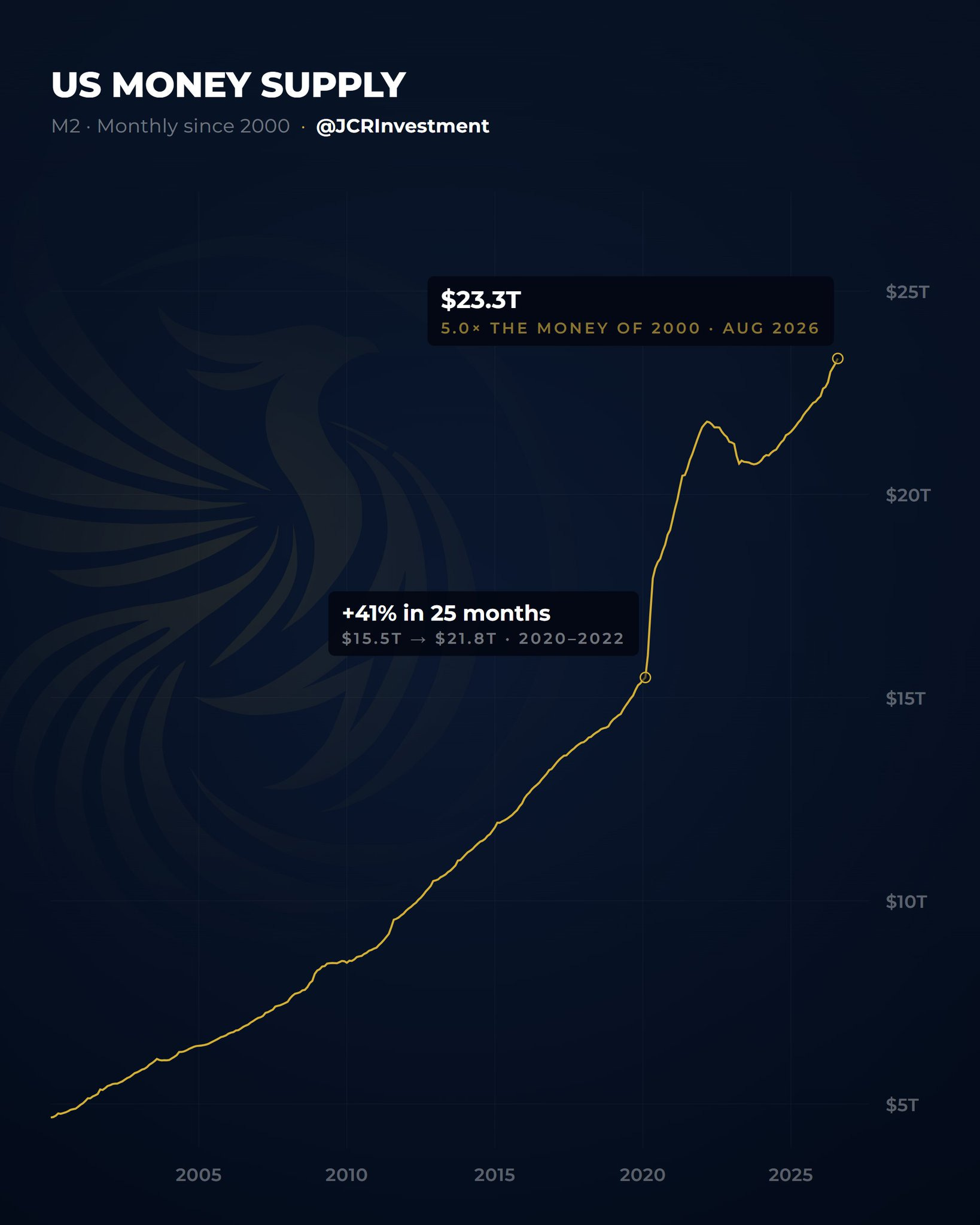
I think this chart alone makes the system you live in clear. One where they never stop printing money to pay the debt, which keeps inflation rising and widens social divides even further.
That’s why I believe home and food prices will keep going up. And that’s why I believe stocks and gold will too, over the long run. Because they won’t stop debasing the currency, and they won’t stop widening these divides.
So even if the news makes it look like the end of the world and the bubble finally bursting, my read is that the correction will end and markets will recover. And I hope 2027 and 2028 turn out to be the kind of years you only see once every couple of decades.
So What Am I Going to Do?
After months of studying everything above, my move is clear.
First, I’ll wait for the markets to correct and fill with panic, just as the whole chain of assets is pricing in.
Second, when everyone is saying the bubble has burst, I’ll buy, for two reasons. One, because the interests of a lot of people with power and money are riding on an AI bubble in 2027 and 2028, one that pays for the infrastructure needed to dominate the technology. Two, because they won’t stop printing money and debasing the currency, and sooner or later that will send markets back up.
That’s why I’ve built a public $40,000 portfolio that I’ll share openly. Every week, we’ll read the market together and see how things unfold.
The idea behind this portfolio is to see how far a long-term investor can go when they understand the world and the market their money and their future depend on. That’s why the $40,000 is fixed. There will be no new contributions, so we can measure the performance clearly.
I’ll share the wins, the mistakes, and everything that happens along the way. I’ve also put together a watchlist of assets I’ve studied and hope to buy during the correction. I’ll share it in upcoming articles.
If There’s One Thing I Want You to Take From This Article, It’s This
I don’t care whether you agree with what I’ve said here today. I’m not looking for anyone’s approval or respect. I don’t care if you’re on the right, the left, or anywhere else. But what I need you to understand is that hard times are coming for the world.
Times that will feel new to all of us, because it’s the first time they’ve happened in our lifetimes. And yet they’ve happened so many times throughout history that we’re just one more stage in this endless loop called human psychology.
I want you to understand that no, you’re not crazy. What you’re seeing is real. If you feel like everything is getting worse, it is. If every time you get paid at the end of the month your paycheck covers a little less, that’s true, and it’s only going to get worse.
They won’t stop printing money, debasing the currency, and making inflation worse.
And what I need you to understand is that you have to protect yourself. You have to protect your money, you have to protect your future, and you have to protect the people you love.
And the best way to do that is to invest. What you invest in is your decision, but you have to do it. Because when things get ugly, it won’t be human kindness or goodwill that saves you.
It will be understanding the world as it really is, and having enough financial strength to face whatever comes, so you can secure your future and the future of the people you love.
Thank you for reading all the way to the end. I know it was a long one, but some things can’t be said in a minute.
See you next week.
J.C. Rodriguez
If someone you care about keeps asking why everything costs more every month, send them this. It won’t fix their paycheck, but it might help them understand what’s happening and protect their money before the next move.