

Natera is one of the fastest-growing healthcare companies of 2026, and yet most people have never heard of it. It’s also the biggest position in Stanley Druckenmiller’s portfolio, more than 16% of everything he holds. And Druckenmiller is one of the greatest investors in the world.
In this article I’ll walk you through everything I found: the parts that make me want to own it, the parts nobody likes to talk about, and the exact price I’m waiting for. Let’s take a look.
What Natera does, in plain words
Natera reads DNA from a simple blood draw.
When cells die, they leave tiny fragments of their DNA floating in your blood. Natera has spent twenty years learning how to find and read those fragments, and it sells tests built on that in three areas:
Pregnancy (Panorama). A blood test from the mother that screens the baby for genetic conditions, with no needle anywhere near the baby. This is where Natera started, and it’s still the market leader.
Organ transplants (Prospera). It detects whether a transplanted kidney, heart or lung is being rejected, before the patient feels anything.
Cancer (Signatera). This is the one that matters. Signatera is the reason the stock has taken off.
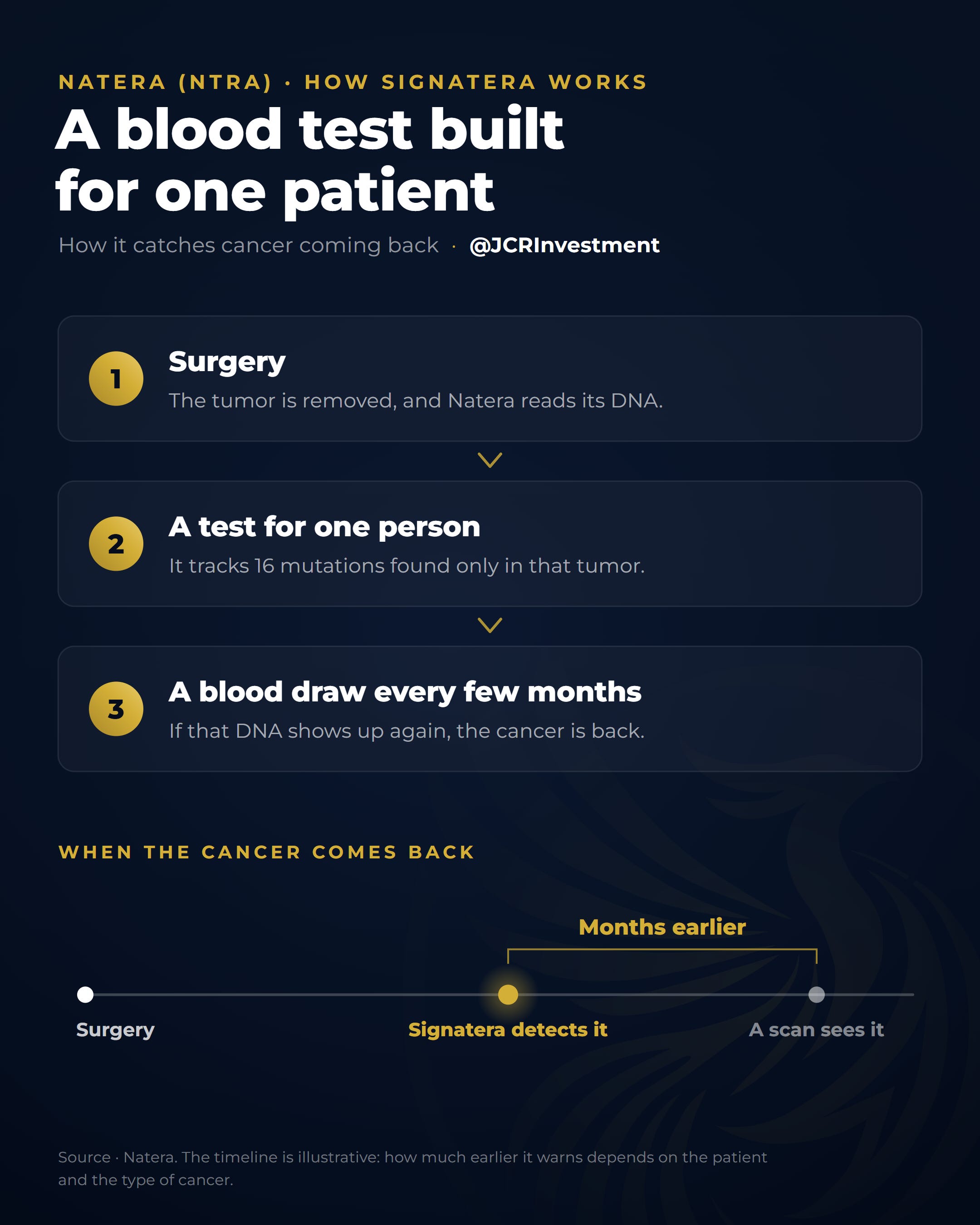
Imagine someone has surgery for colon cancer. The tumor is removed, the scans come back clean, and the doctor says everything looks good. But one question remains: did a few cancer cells stay behind?
Signatera answers that question. Natera sequences the patient’s own tumor, builds a test designed only for that person, and then checks their blood every few months. If the cancer’s DNA shows up again, the test can catch it months before any scan would.
Two things make this a very good business:
It’s personal. Every test is built around one patient’s tumor. Once a patient starts with Signatera, they don’t switch.
It repeats. It’s not a single test. It’s one every few months, for years. Each patient becomes recurring revenue.
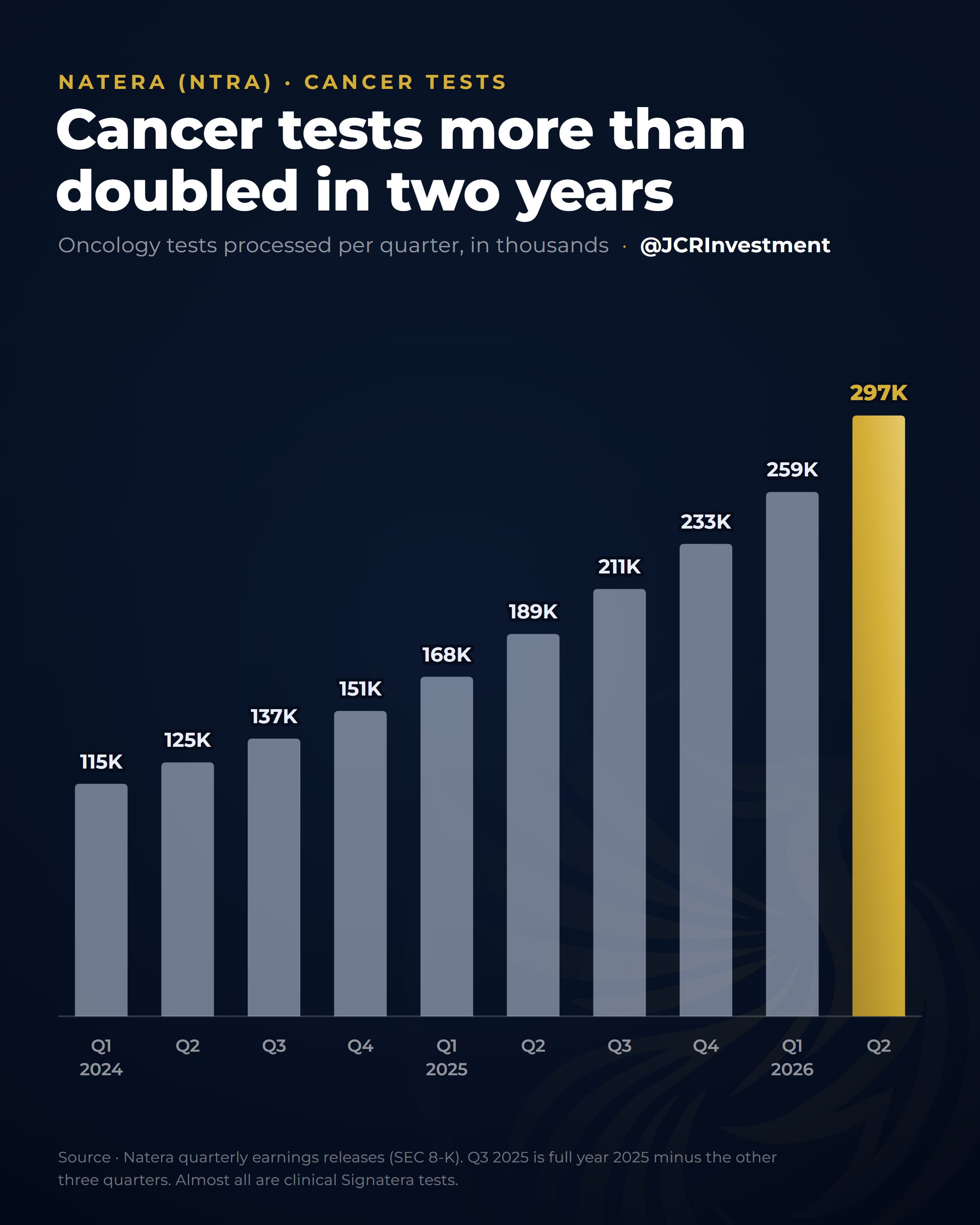
And it’s growing very fast. In the second quarter, Natera ran 296,700 cancer tests, 57% more than a year earlier. The average price of a Signatera test rose to around $1,275. And in May, the FDA approved it as a companion diagnostic for bladder cancer, the first approval of its kind in this market.
Natera is the clear leader. Signatera has more than 100 published studies behind it, and close to half of all oncologists in the US already order it.
Now that you know what Natera does and why it’s such a good business, let’s look at what the future holds, what the fundamentals say, and the price at which it becomes a great stock to buy.
What really moves Natera’s stock
Here’s something most people miss. Natera’s business doesn’t depend on the economy. Cancer doesn’t stop because there’s a recession, and patients keep needing their tests whatever the stock market does.
But Natera’s stock is a different story. It depends on one thing above all: how much money is flowing through the markets.
Look at what happened in the last few years:
2020–2021: the Fed printed money like never before. Natera went from around $25 to $129.
2022: the Fed started draining that money. Natera fell 80%, while the business kept growing the whole way.
2023–2026: money started flowing back into the markets, and Natera climbed all the way to a new high of $437.
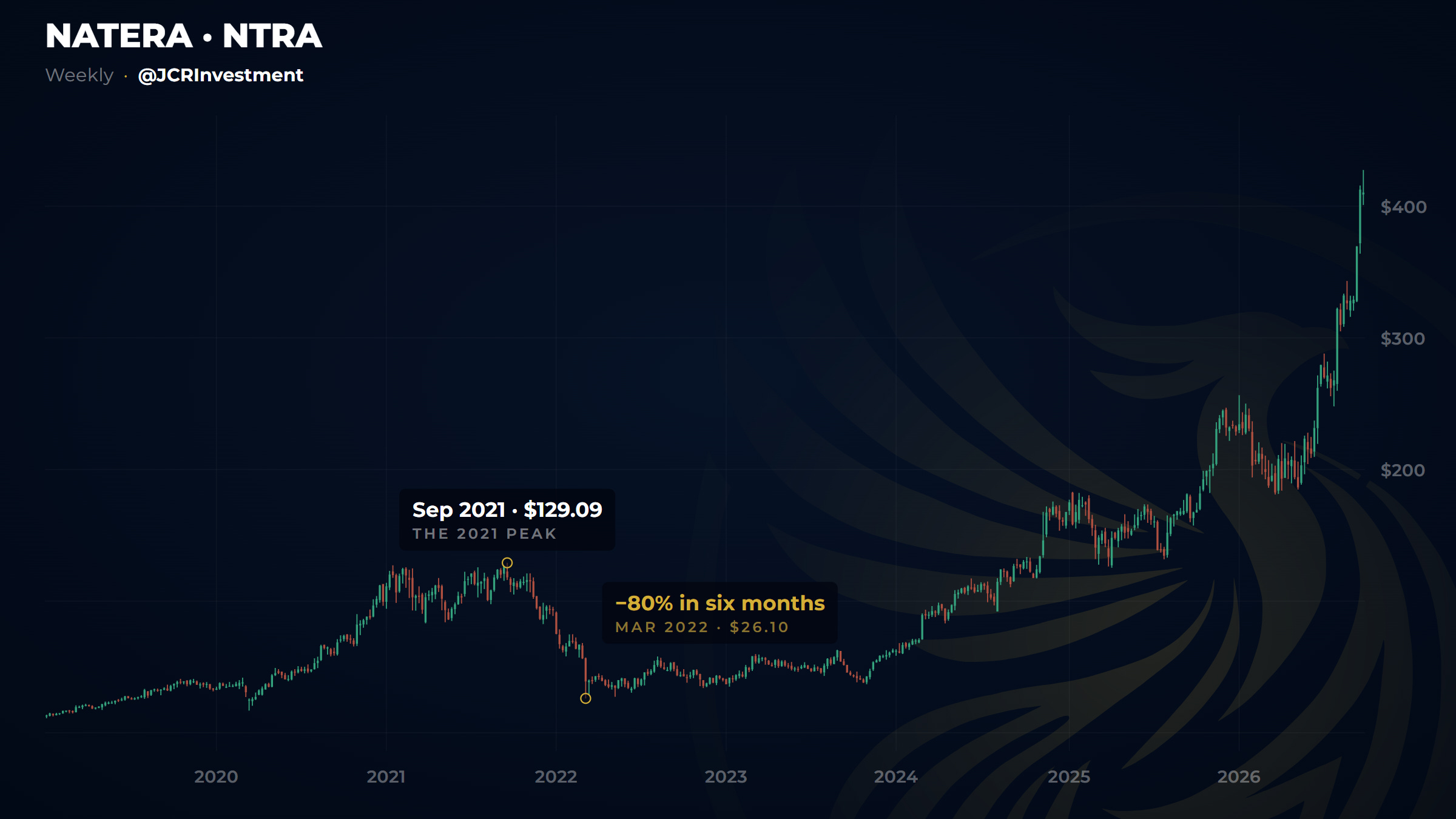
Same company, same growing business. What changed was the money around it. That’s why I call Natera a liquidity stock: a company that is growing fast but doesn’t make a profit yet. Investors pay for its future, and they only pay generously when money is easy.
Where are we now?
Right now, the market is in a late phase of expansion. The economy is still healthy, companies are earning record profits, and money keeps flowing. That’s good news for a stock like Natera, and it could stay that way for a couple more years, as long as liquidity keeps coming in.
But late phases have a catch: corrections become more violent. The most speculative corners of the market are already showing cracks, and when money gets nervous, it sells first what it bought with the most enthusiasm. A stock that has gone up more than 70% in a year without profits is right at the front of that line.
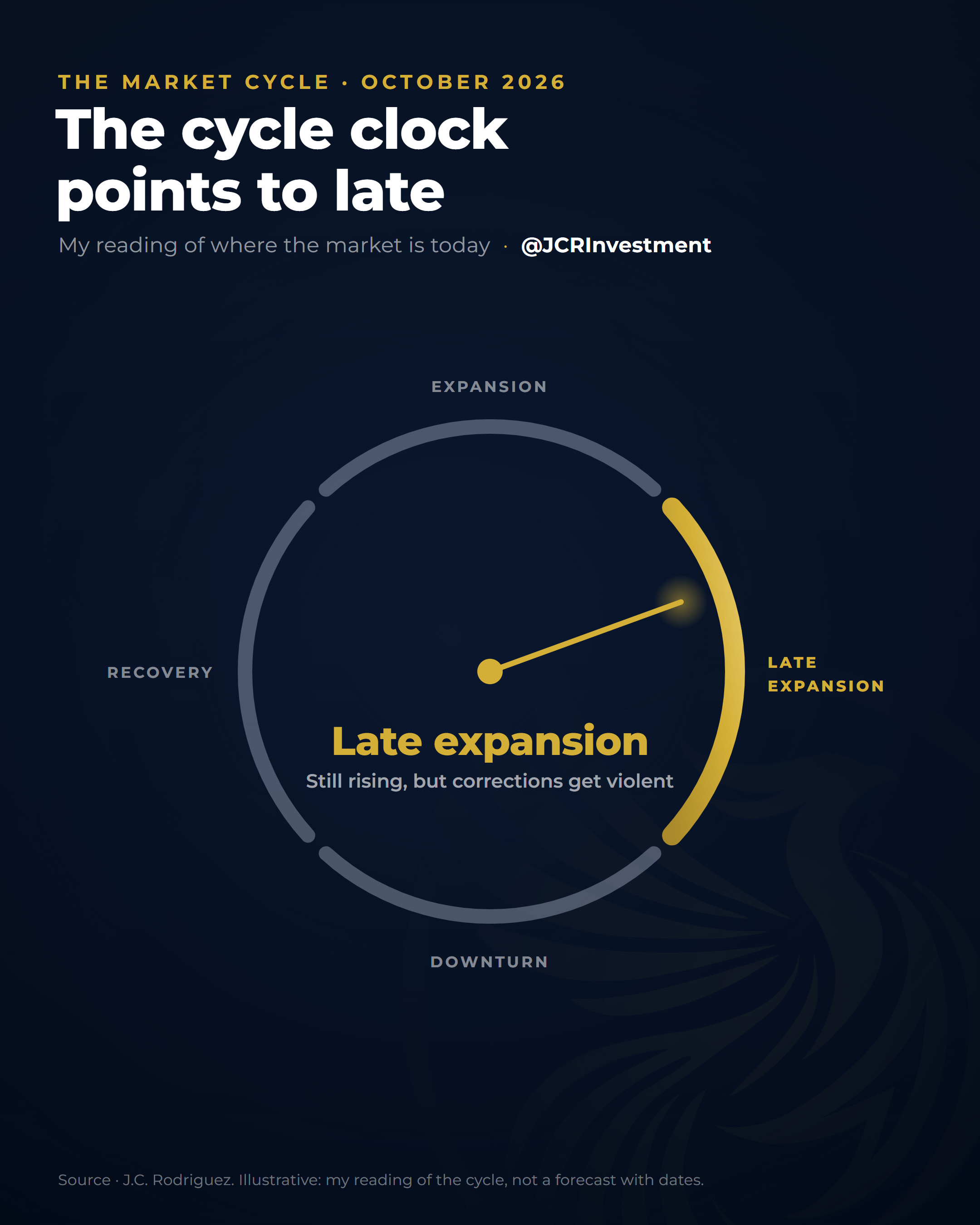
So my view is simple: Natera still has the wind at its back for the next few years, but I expect a sharp correction first. And that correction is exactly what will give us the entry.
What I’m watching
Three signals tell me whether that wind is still blowing:
Liquidity: whether the money available in the system keeps rising or starts to shrink for several months in a row.
The Fed: in September it raised rates again, for the first time since 2023. One hike is a warning. If more follow, the wind starts to turn.
Credit: whether the extra interest paid by riskier companies starts to climb. That’s usually the first sign of fear.
As long as these three hold, any big drop in Natera is an opportunity. If they all turn at once, the drop could go much further than my entry, and I’ll wait.
Strong business, expensive habits
Now let’s look under the hood. Natera’s numbers tell two stories at the same time: a business that is growing like few others, and a company that is still paying for that growth in ways shareholders don’t always see.
Revenue is exploding
In 2019, Natera made $302 million. In 2025, it made $2.3 billion. And for 2026, management expects around $2.88 billion, after raising its guidance by $100 million in August.
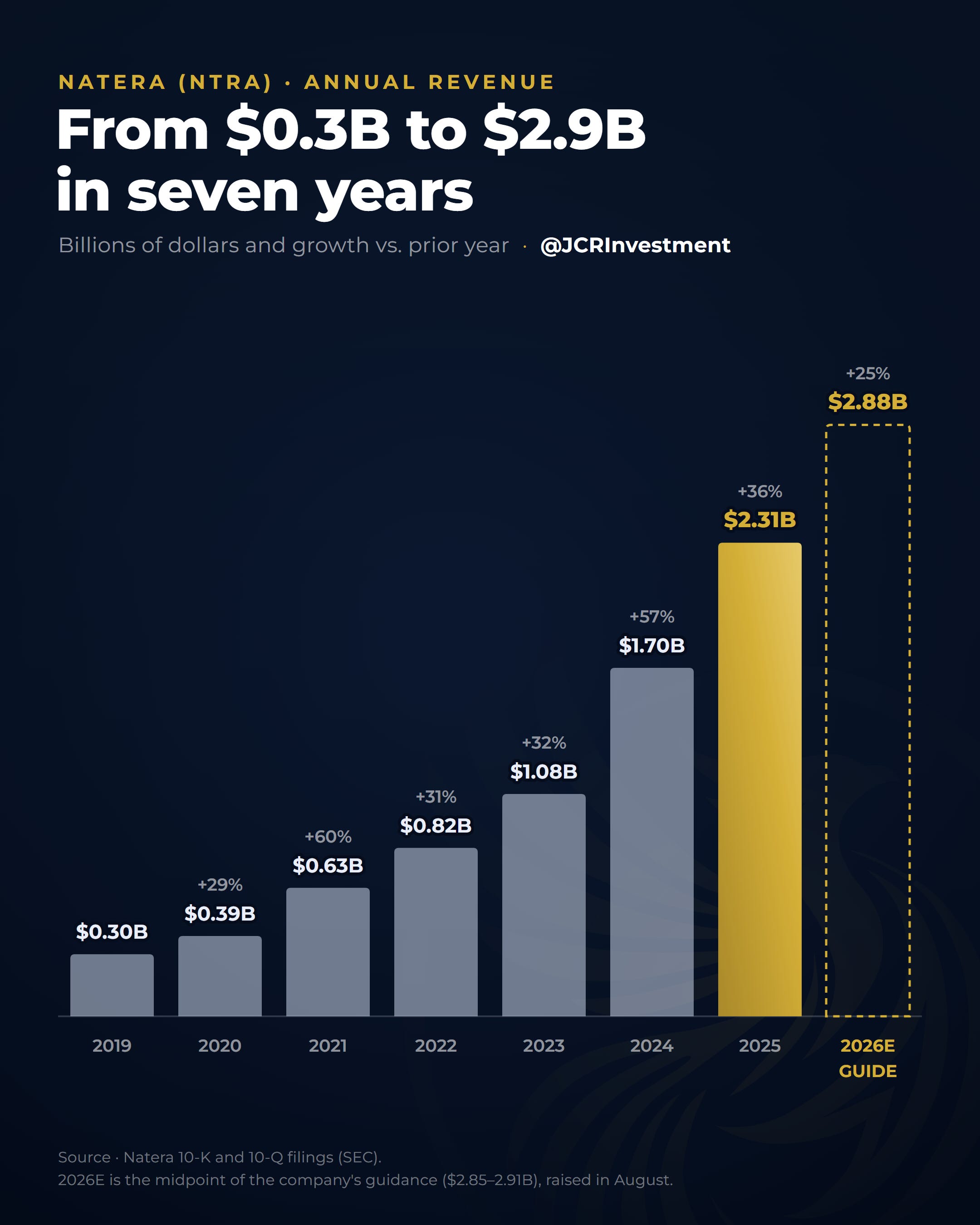
That’s almost ten times more revenue in seven years, and it isn’t slowing down. In the second quarter, revenue grew 37.7%, and gross margin improved to 64.5%. In other words, for every $100 it sells, $64 is left after paying for the tests themselves.
Losses are shrinking, but they’re still there
Natera has never made money over a full year. But the trend is clearly heading in the right direction. Its losses peaked in 2022 at $548 million. Over the last twelve months they were $192 million, while revenue more than doubled.
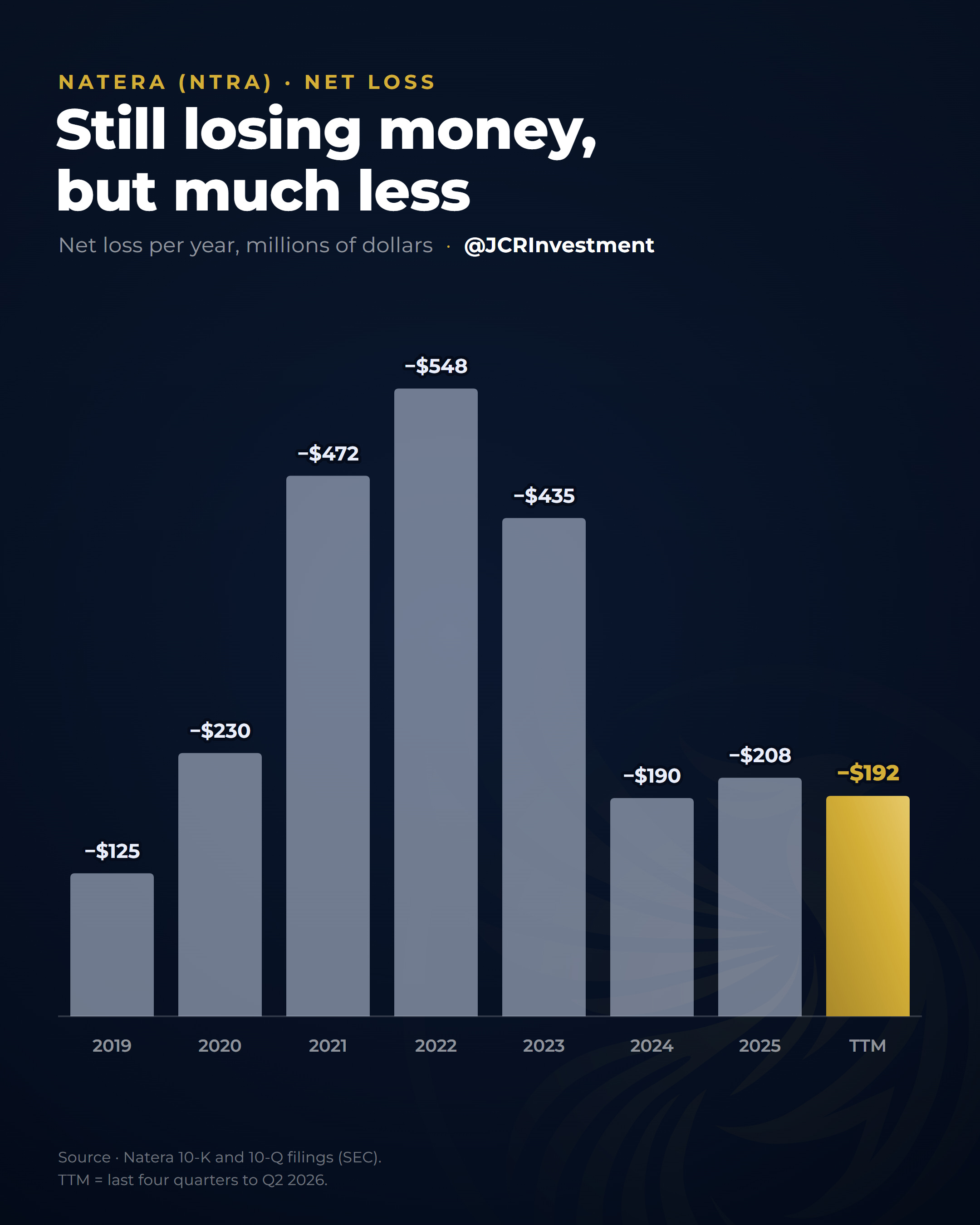
And the balance sheet gives it all the time it needs: $1.09 billion in cash and only $80 million in debt. Natera is not going to run out of money.
The detail almost nobody mentions
You’ll read that Natera is now “cash flow positive”. Technically, it is. Over the last twelve months it generated $84 million of free cash flow.
But in that same period, it paid $381 million to its employees in shares instead of cash. That’s four and a half times more.
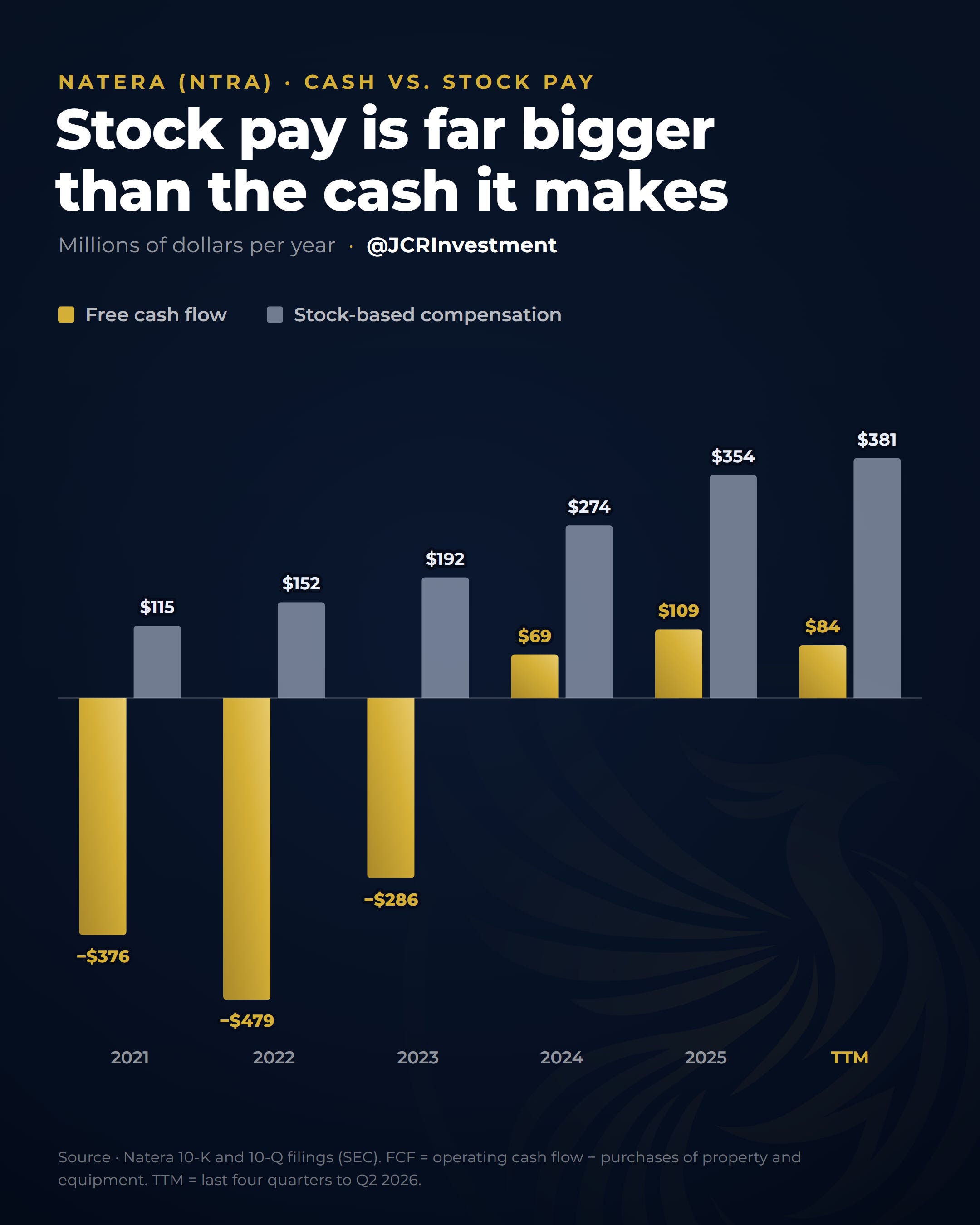
Why does that matter? Because every time a company creates new shares, your slice of the company gets smaller. Natera has done it in two ways: paying its people in stock, and selling new shares to raise cash in the years it was burning money. And it doesn’t buy back shares to make up for it.
The result: today there are twice as many Natera shares as in 2019.
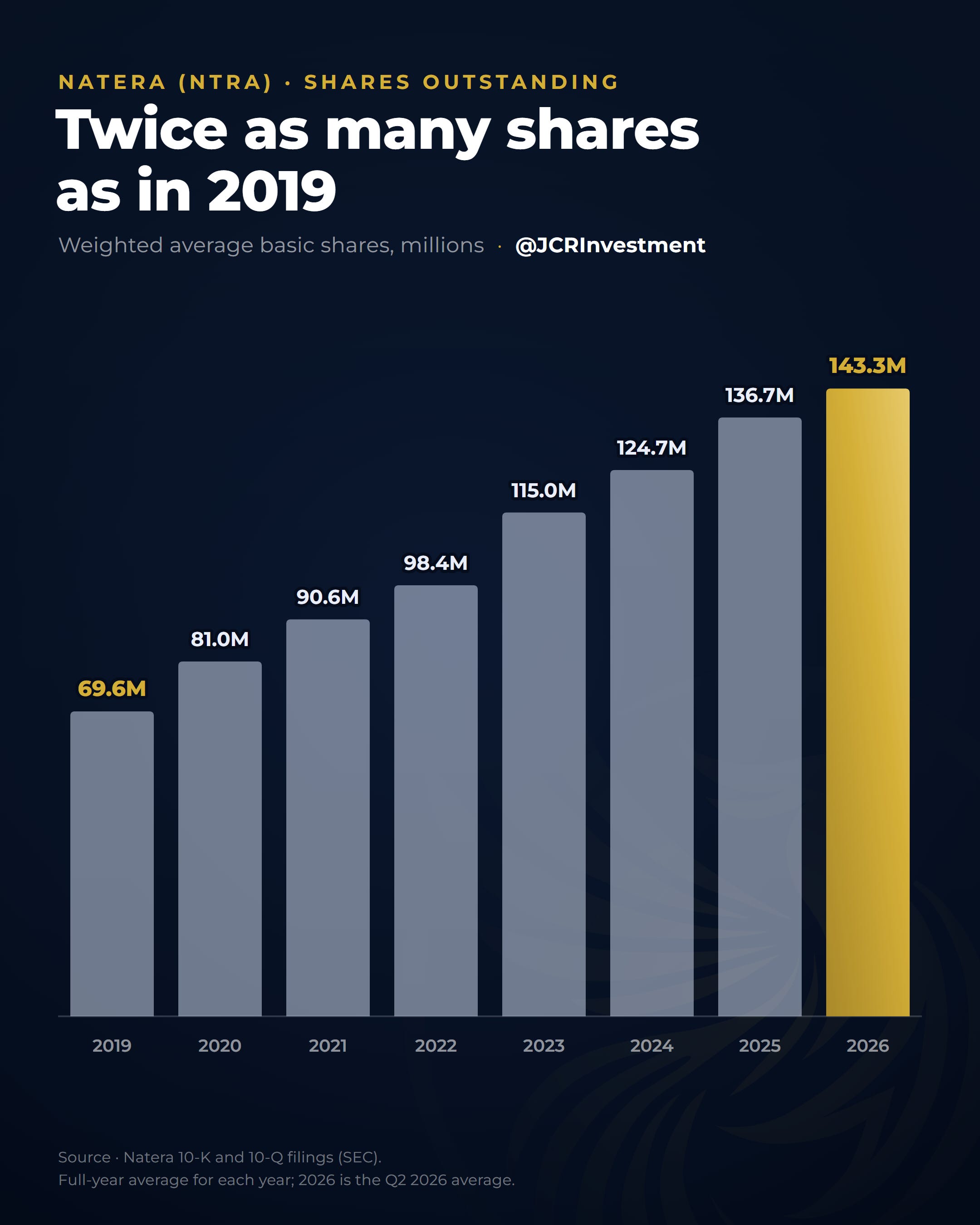
Put it all together: revenue has grown almost 8 times since 2019, but each share now owns half the slice of the company it owned back then. The business has grown fantastically. The shareholder’s piece of it, a lot less.
It’s not a red flag on its own. Almost every fast-growing tech and biotech company does it. But it’s one of the things I check before buying anything, and here it doesn’t pass.
How Natera scores on my checklist
Every company I consider has to pass the same filter. Twelve questions, no exceptions. This is how Natera does:
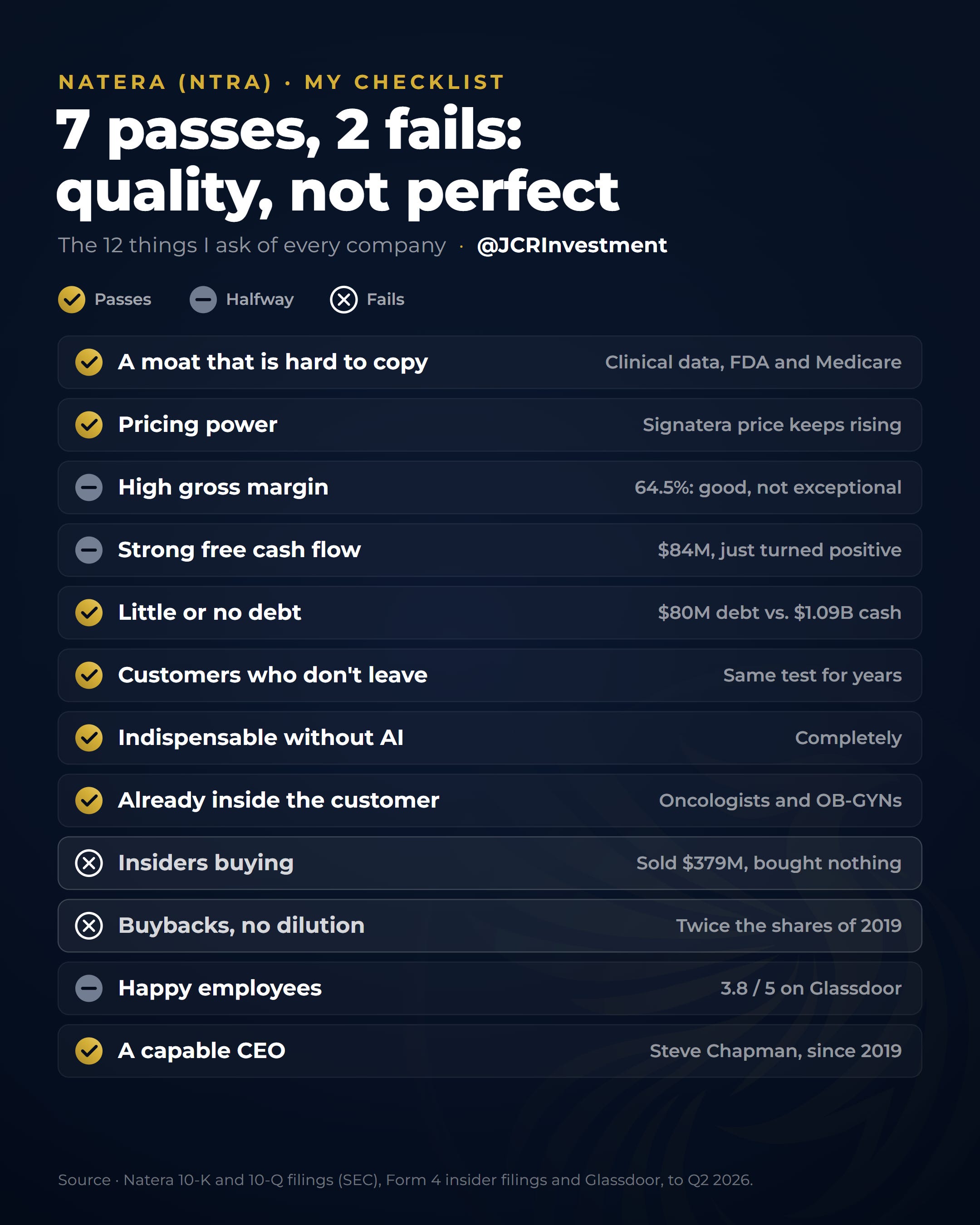
Seven clear passes, three in the middle, two fails. The business itself is excellent: a real moat, pricing power, customers who stay for years, and a balance sheet with no worries. Where it falls short is in how it treats its shareholders. Insiders sold $379 million in the last twelve months without buying a single share, and the share count keeps growing.
That’s a quality company, not a perfect one. And that matters for two things: the price I’m willing to pay, and how much of my portfolio it deserves. A company that passes every test can earn a big position. One that fails two of them gets a smaller one, bought at a price that leaves room for mistakes.
The competition is getting serious
Natera leads this market, and by a lot. But the giants have noticed.
Abbott, one of the biggest healthcare companies in the world, bought Exact Sciences in March. Exact has its own personalized cancer test, and now it has Abbott’s sales force behind it.
Tempus bought Personalis in July, adding one of the most sensitive tests on the market to its huge network of oncologists.
Guardant Health sells a test that doesn’t need the tumor. It’s easier to order but less precise, and so far it hasn’t caught up.
Natera’s lead is real: years of studies, the first FDA approval of its kind, and half of US oncologists already using it. But two years ago it competed with small companies. Now it competes with Abbott. That’s a different game.
The part nobody likes to talk about
If I tell you a company is great, I also have to tell you its history. And Natera’s has some dark chapters:
2018: it paid $11 million to settle US Department of Justice allegations over how it billed its pregnancy test.
2022: The New York Times reported that, for some rare conditions, its prenatal test’s positive results were wrong more than 80% of the time. Natera later settled the class action for $8.25 million.
March 2022: short seller Hindenburg Research accused it of deceptive billing toward doctors, insurers and expectant mothers. The stock fell 33% that day. Five days later, a jury found Natera had made false advertising claims about its transplant test.
2024: another jury ordered it to pay Guardant $292.5 million for false advertising against its cancer test. Natera has appealed.
What do I take from all this? Natera has sold its tests very aggressively, too aggressively more than once. $292 million won’t sink a company with $1.09 billion in cash. But it says something about the culture, and it’s a risk you have to accept with your eyes open.
It already prices in a lot of future
So why am I not buying? Because a great company and a great investment are not the same thing. The difference is the price you pay.
At $392, Natera is worth around $57 billion. That’s almost 20 times the revenue it expects for all of 2026, for a company that still doesn’t make a profit.
That can be justified if everything goes right for years. But at 20 times sales, the market doesn’t forgive. A slower quarter, a cut in what Medicare pays, or a strong move from Abbott, and the stock can lose a third of its value in a few weeks.
The price I’m waiting for
This is Natera’s weekly chart. For years, the stock moved inside a long channel. It broke above it, came back to test it in 2025, and from there it took off. This summer it went almost vertical: from around $200 to $437 in a few months.
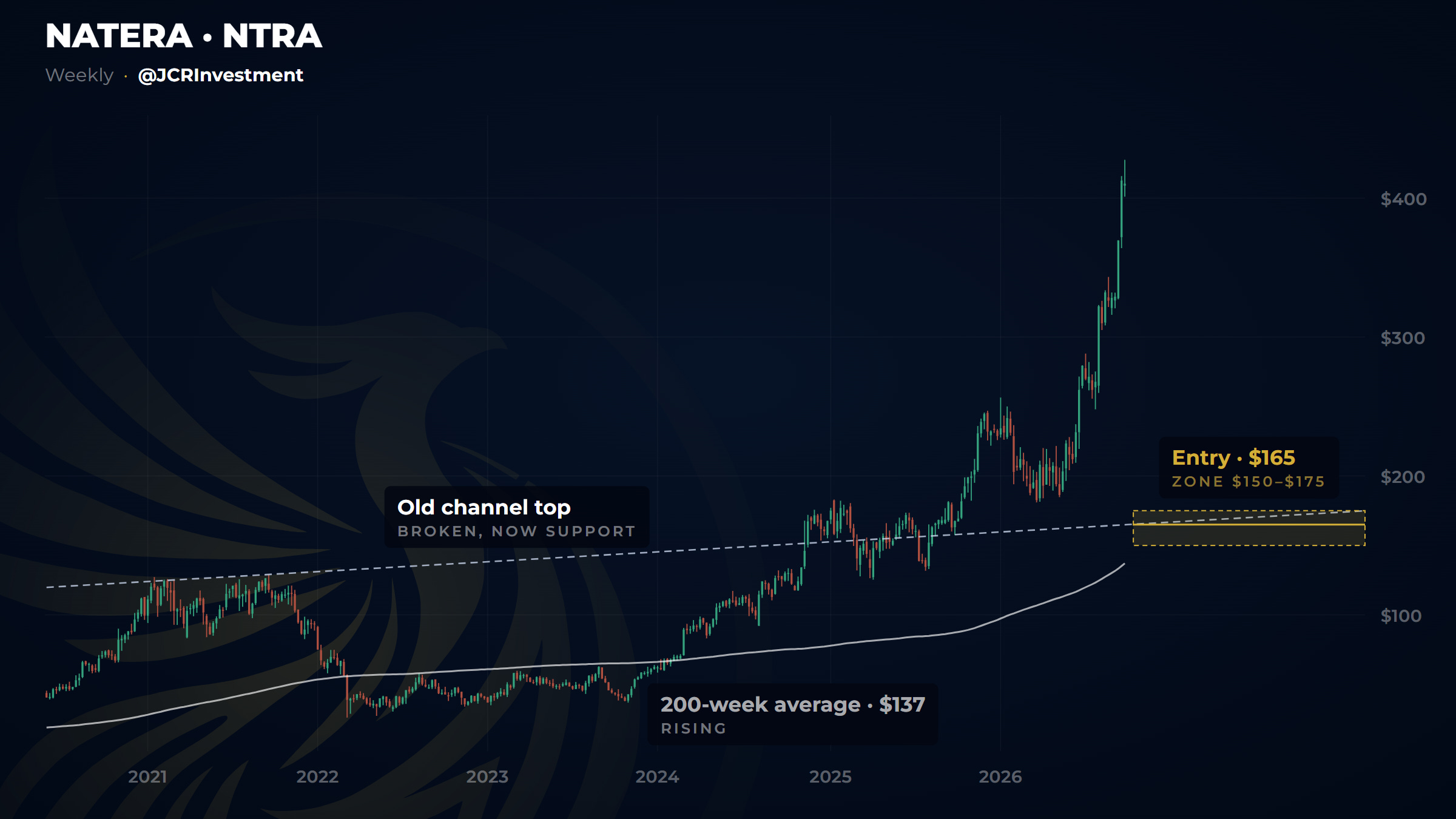
Moves like this rarely hold. They usually come back to test the zone they broke out from. And in Natera’s case, two things line up there:
The top of its old channel. It used to be the ceiling, and now it’s the support. Today it sits around $165.
Its 200-week average. It’s at $137 and rising fast, getting closer to that same zone every week.
When an old ceiling and the 200-week average meet in the same place, that’s the kind of support I trust most.
$165, that’s my entry, within a zone between $150 and $175.
I know it looks very far from $392: it’s a 58% fall. But this same stock fell 80% in 2022 with the business growing the whole way. And at $165, Natera would be worth around 8 times its sales instead of 20.
So, is Natera stock a buy?
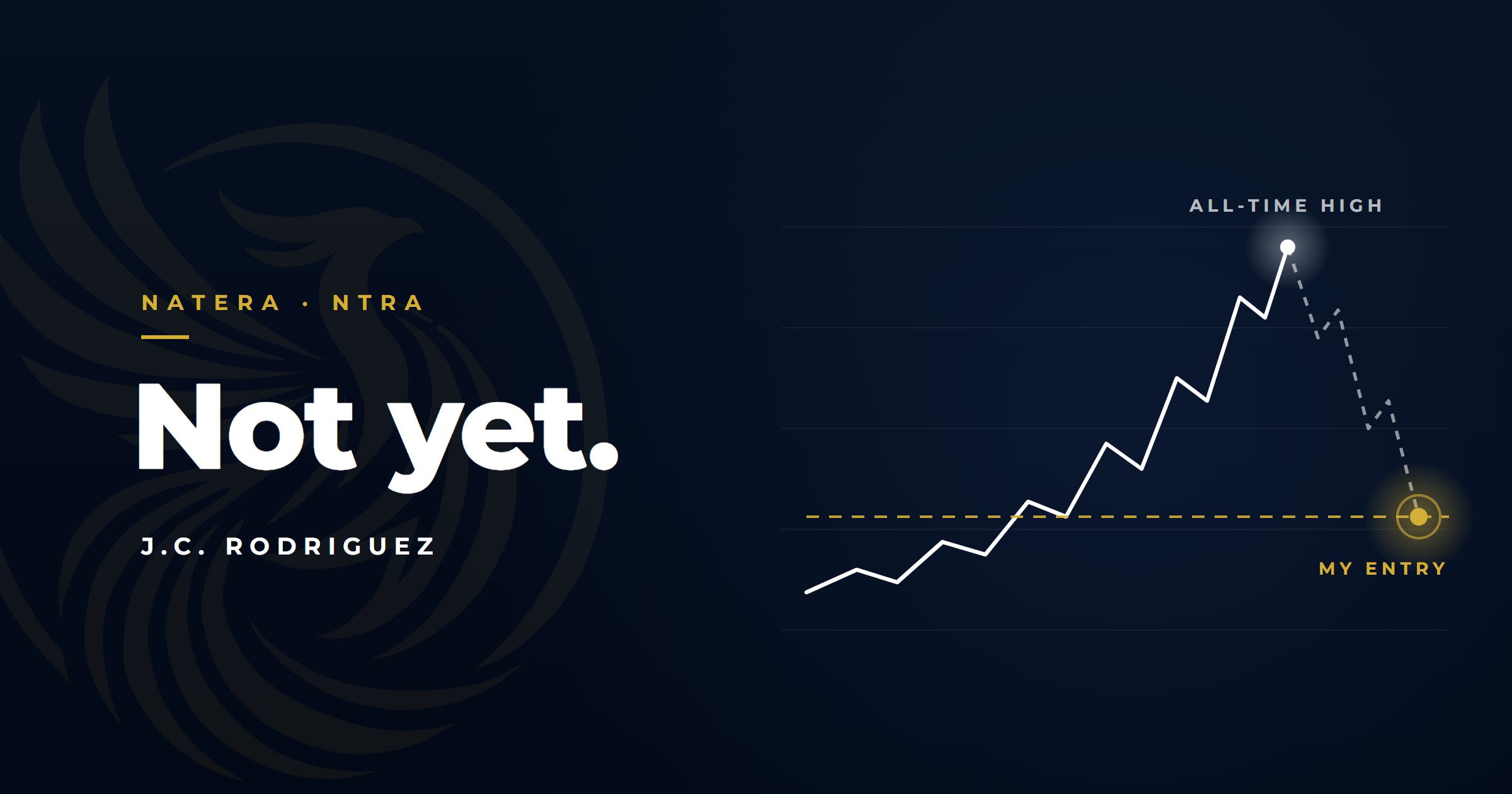
Not yet. Natera is one of those companies that make you want to buy right away: a product that saves lives, a clear leader, revenue growing almost 40%, and one of the best investors in the world with his biggest bet on it.
But the best businesses aren’t always the best investments. Not at any price, and not at any moment in the cycle.
So here’s my plan:
I’m not buying now. My portfolio is still in cash, waiting for the correction I’ve been describing since August.
If Natera reaches the $150–175 zone, I’ll buy in steps, not all at once. Nobody catches the exact bottom.
It will be a smaller position than my best ideas, around 3–5% of the portfolio. A company that fails two of my tests doesn’t get a big one, however good the business is.
Before each buy, I’ll check that the story still holds: Signatera growing above 40%, Medicare still paying what it pays today, and the Guardant appeal not turning into something bigger.
If the business breaks, I won’t buy, however cheap it gets. A falling price is only an opportunity if the company is still the same.
Every week, I share the best opportunities I find in great companies, along with an update on where the market stands and what to expect in the weeks ahead. Subscribe so you don’t miss a thing.
Good luck out there in the markets, investor. Patience, a cool head, and decisive action.
All the best,
NTRA crushing it though